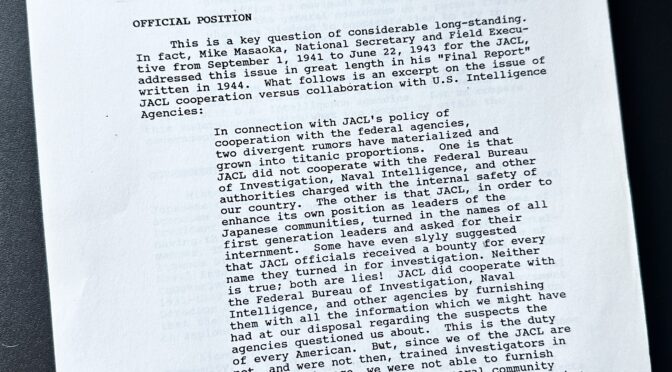
With a new generation of interest in the wartime incarceration of Japanese Americans, I’m fielding more inquiries about the JACL’s 1990 research report into its own wartime activities, a document commonly known as “The Lim Report.” One thing led to another, and we’ve quickly put together this workshop for the Tule Lake Pilgrimage on Sunday, July 5, at 8:00 am in the big College Union Auditorium:
Continue reading A brief history of “The Lim Report” and how it came to be
Category Archives: Tule Lake

Excavating Stories and Unearthing History in Fall 2024
The weather is turning, and it appears to be time to hit the road again starting this weekend, mostly to promote the new Penguin anthology but also to meet continuing interest in the graphic novel and camp resistance in general. Here’s the list as it stands today of in-person and virtual speaking events for this fall, including serving as headliner for the Densho annual fundraiser. Check the Events page for further updates.
Continue reading Excavating Stories and Unearthing History in Fall 2024

Project to translate and republish the literary magazines of Tule Lake
Tule Lake is the final frontier for the study of Japanese American incarceration. After 80 years, the Segregation Center at Tule Lake remains the least-understood and most-avoided subject in polite Japanese American society. And the fiction and poetry written by the Issei and Kibei Nisei during this tumultuous period and published in the camp’s literary magazines has languished unread by those who can’t read Japanese. A new project launched last month at the University of California at Berkeley promises to change that. Continue reading Project to translate and republish the literary magazines of Tule Lake
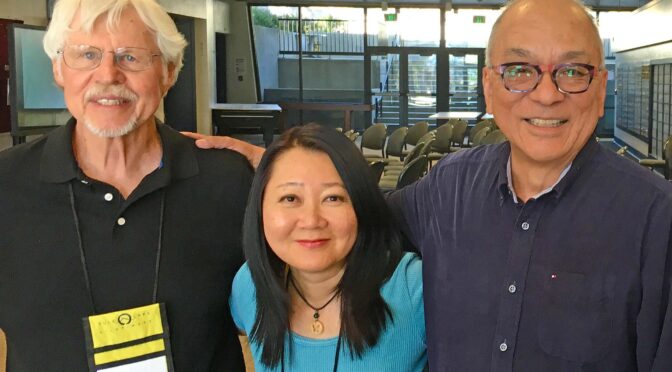
In Memoriam: Martha Nakagawa, resistance storyteller
This is one of the hardest things I’ve had to contemplate writing. These In Memoriam posts have mostly been devoted to celebrating the lives and marking the passage of Nisei wartime resisters and those whose lives they’ve touched. I know I’m not alone in still being in a state of shock at having to memorialize the life of someone so young and vital as Martha Nakagawa of Los Angeles.
Continue reading In Memoriam: Martha Nakagawa, resistance storyteller

Finding the true location of the Tule Lake Stockade
 The Tule Lake Stockade was “an instrument of terror in camp. You could be arrested with no hearing and no charge, just picked up. You didn’t know who you could talk to safely, or what to say. If you were picked up, what you said was the reason. And whoever heard that might be the inu who informed on you. This created real paranoia in camp.”
Continue reading Finding the true location of the Tule Lake Stockade
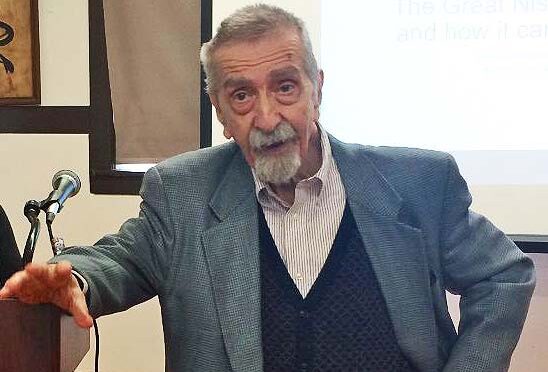
In Memoriam: Roger Daniels, the dean of incarceration camp history
We mourn the loss of the dean of Japanese American camp history. Roger Daniels passed away peacefully in Bellevue, Washington, on December 9, surrounded by family, a week after celebrating his 95th birthday.
Continue reading In Memoriam: Roger Daniels, the dean of incarceration camp history
The difference between “no-no boys” and draft resisters
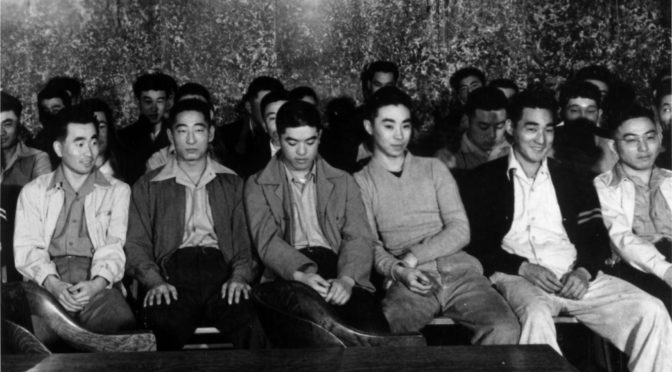
It’s common in books and articles to see the term “no-no boy” conflated with the Nisei draft resisters of WW2. These are two seperate and distinct groups. A quick primer:
 “No-no boys” were among the 12,000 from all ten camps who answered “no” or refused to answer the final two questions on a notoriously misleading government questionnaire in early 1943. This led to their removal from camp and transfer under an administrative process to a War Relocation Authority Segregation Center established as a kind of penal colony at Tule Lake.
 “Draft resisters” were the roughly 315 young men from all ten camps who in general answered “yes” or a qualified “yes” to the questionnaire but who, a year later in 1944, refused to be drafted from inside an American concentration camp until their rights were first restored and their families freed to return home. All but 22 were criminally convicted in U.S. District Court of violating the Selective Service Act. The older men were sent to Leavenworth Federal Penitentiary in Kansas; the younger ones were sent to McNeil Island Federal Penitentiary south of Seattle.

What blurs this distinction is the title of John Okada’s 1957 novel. It’s titled No-No Boy but it’s clearly about a protagonist who refuses the draft at Minidoka and serves two years at McNeil Island before arriving on a bus back in Seattle at the start of the novel. Despite the book’s title, he’s a draft resister, not strictly speaking a “no-no boy.” However, the term is used in the novel and in conversation at the time as a dismissive slur for any kind of camp dissident.
Please keep these distinctions in mind when writing about this history.

First preview of our forthcoming anthology of camp literature
For three years, Floyd Cheung of Smith College and I have been gathering pieces and building the outline for a new anthology of camp literature commissioned by the publisher of Penguin Classics. On Sunday I presented a preview of our work on translations of Issei writing in camp in Japanese, part of what the late Yuji Ichioka called “our buried past.” This video screen is cued to the start of that discussion:
Continue reading First preview of our forthcoming anthology of camp literature
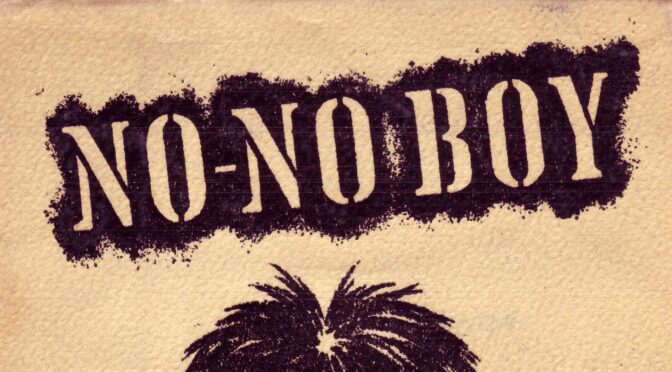
Demystifying Book Titles: Greg Robinson on the title for “No-No Boy”
An unexpected blog post just arrived from our JOHN OKADA co-editor, Greg Robinson, on his theory of how Okada’s novel came to be published under the title of NO-NO BOY. Continue reading Demystifying Book Titles: Greg Robinson on the title for “No-No Boy”

YouTube preview of forthcoming graphic novel, “We Hereby Refuse”
“Three voices … Three acts of defiance … One mass injustice.” That’s one of the taglines for our forthcoming graphic novel which presents an original vision of America’s past with disturbing links to the American present. We had a fast-moving conversation about it on Black Friday, with a special look inside the 3-D modeling by one of our two artists, Ross Ishikawa, to recreate key scenes based on historical reality.
Here’s the one-hour JAMP YouTube channel event moderated by Erin Aoyama, to get you ready for publication on February 9, 2021.
Continue reading YouTube preview of forthcoming graphic novel, “We Hereby Refuse”