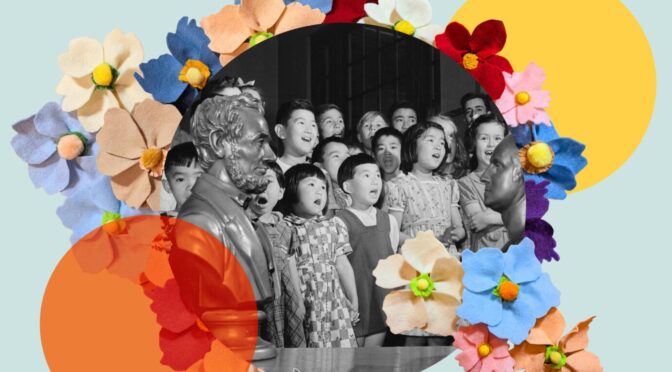
 The following is adapted from a short talk I gave January 10 at the Museum of History and Industry in Seattle, in advance of an exhibit opening today of traditional Boys’ and Girls’ Day dolls that were entrusted to a beloved school principal by Japanese American families facing forced removal in 1942.

Before World War II, Bailey Gatzert Elementary School was located at 12th and Weller near Seattle Chinatown and its students were drawn from the neighborhood’s Japanese and Chinese immigrant families. You can see how strongly Asian the classes were. Nearly half the students were Japanese Americans.

The school’s principal, Ada Mahon, is seen standing in the center in the back with the light hair. As I wrote in my biography of novelist John Okada, Miss Mahon was known to be “‘Irish tough’ and proud,” revered for teaching charges to embrace their Asian heritage even as she schooled them in what it meant to be American, and to see themselves as Americans.
She told The Seattle Times that there is no racial prejudice among her students. “We like to refer to our student body as ‘little democracy.’ We attribute our success to the work of our Good American Citizens’ Club which is made up of upperclassmen of the fifth and sixth grades. The students organize many committees, such as committee for clean grounds, good deeds, safety, clean shoes, turn-off-the-faucets and activities like that. The children are so busy helping each other, they have no time for developing prejudices.”

Miss Mahon’s “Good American Citizenship Club,” met on Wednesday mornings before class and opened with the Pledge of Allegiance and a singing of “America,” according to future Seattle City Councilmember Dolores Sibonga, who told me that after school, Miss Mahon would line up the students and march them out single-file to the strains of more patriotic music played on a 78-rpm record.

One of the students photographed with Miss Mahon is thirteen-year-old John Okada. He’s at the bottom right with the dark shirt and bolo tie. Okada would grow up to write the foundational novel of the Japanese American incarceration, No-No Boy, and in it he has a character talk very much like someone who belonged to Miss Mahon’s “Good American Citizenship Club.”

“I can remember how full I used to get with pride and patriotism when we sang `The Star-Spangled Banner’ and pledged allegiance to the flag at school assemblies, and that’s the feeling you’ve got to have … Next time you’re alone, pretend you’re back in school. Make believe you’re singing `The Star‑Spangled Banner’ and see the color guard march out on the stage and say the pledge of allegiance with all the other boys and girls. You’ll get that feeling flooding into your chest and making you want to shout with glory. It might even make you feel like crying.”
But after Japan attacked the U.S. at Pearl Harbor, this patriotism wasn’t enough to keep the FBI from swiftly knocking on doors and taking away 100 of the fathers of these children. Congressmen, newspaper columnists, and farming interests call for the removal or even deportation of anyone who shares the same race as the wartime enemy. No trials, no due process, no equal protection under the law, just round them up and ship them off. Sound familiar?

On February 19, 1942, President Roosevelt caves to the pressure and signs an executive order to authorize the removal of anyone it chooses from military exclusion zones. On March 23, the Seattle Times localizes the story to the impacts on schools. “There will be 320 vacant desks in the Bailey Gatzert Grade School when the army decides it is time for Japanese” to be forcibly removed from Seattle. On April 24th, the Army has decided, and nails posters to telephone poles giving the Japanese in Seattle until May 1st – one week – to pack up only what they can carry in two suitcases and report to designated assembly points for mass removal. In a panic, frantic families dispose of cars, washing machines, anything they can get ten cents on the dollar for. Some can’t or don’t want to sell their Hinamatsuri doll sets and they leave them with people they can trust – people like Principal Ada Mahon at Bailey Gatzert School.
Monica Itoi was also a student at Gatzert, and as Monica Sone she writes in her memoir, Nisei Daughter, of the scene as her family drove from Beacon Hill to Eighth and Lane in Seattle Chinatown to report for removal to hastily constructed shacks at the Puyallup Fairgrounds:
 “Automobiles rolled up to the curb, one after another, discharging more Japanese and more baggage. Finally at ten o’clock, a vanguard of Greyhound busses purred in and parked themselves neatly along the curb. The crowd stirred and murmured. The bus doors opened and from each, a soldier with rifle in hand stepped out and stood stiffly at attention by the door. The murmuring died. It was the first time I had seen a rifle at such close range and I felt uncomfortable. This rifle was presumably to quell riots, but contrarily, I felt riotous emotion mounting in my breast…. When all the busses were filled with the first contingent of Japanese, they started creeping forward slowly. We looked out of the window, smiled and feebly waved our hands at the crowd of friends who would be following us within the next two days. From among the Japanese faces, I picked out the tall, spare figures of our young people’s minister, the Reverend Everett Thompson, and the Reverend Emery Andrews of the Japanese Baptist Church. They wore bright smiles on their faces and waved vigorously as if to lift our morale. But Miss Mahon, the principal of our Bailey Gatzert Grammar School and a much-beloved figure in our community, stood in front of the quiet crowd of Japanese and wept openly.”
Miss Mahon may not have protested. She did not march in the streets. She did not blow whistles. She did not block the buses with her SUV. But she did what she could for the times. She showed up to stand in support and bear witness.

And she did so because she knew that empty desks would greet her at Bailey Gatzert when she returned to work. Nearly half of her students disappeared from their classes, as if the act of a regime in some third world country.

Some families returned after the war to retrieve their dolls, but many did not. Miss Mahon retired in 1949. And the Japanese American families with children in her care showed their love for Miss Mahon by raising money to send her on a retirement cruise to Japan, in 1950.
Fifty-three dolls remained at Bailey Gatzert until 1973, when they were transferred to MOHAI. And those are the dolls that are featured in the exhibit curated by artist Miya Sukune that is opening today, “TADAIMA: ‘I’m Home!’ Bringing Seattle’s Girls’ and Boys’ Day Dolls Home.”
