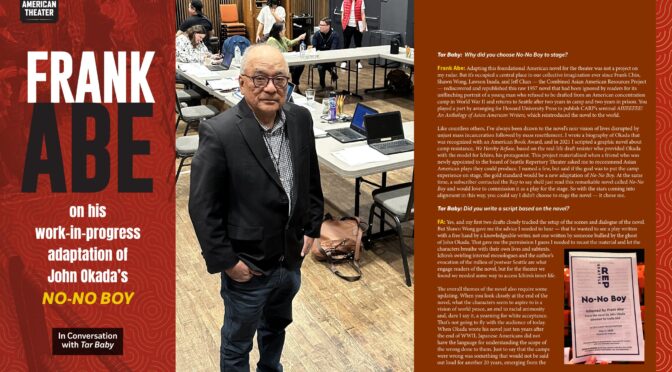
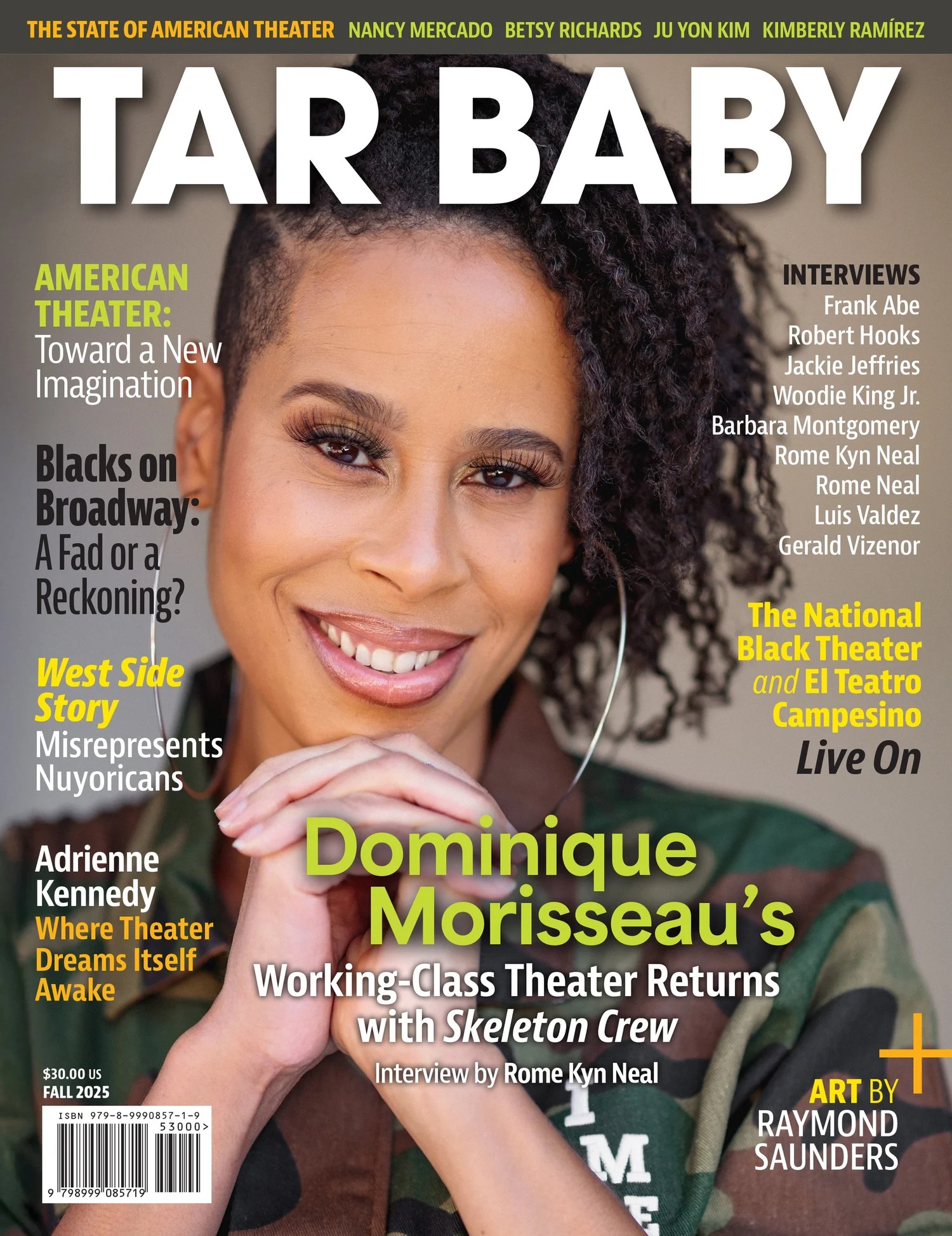
 It’s unbelievable to be among Luis Valdez, Robert Hooks, and others interviewed for the American theater issue of Tar Baby, a new quarterly journal published by the Toni Morrison Foundation that “connects a global community of intellectuals, artists, educators, and cultural enthusiasts.”
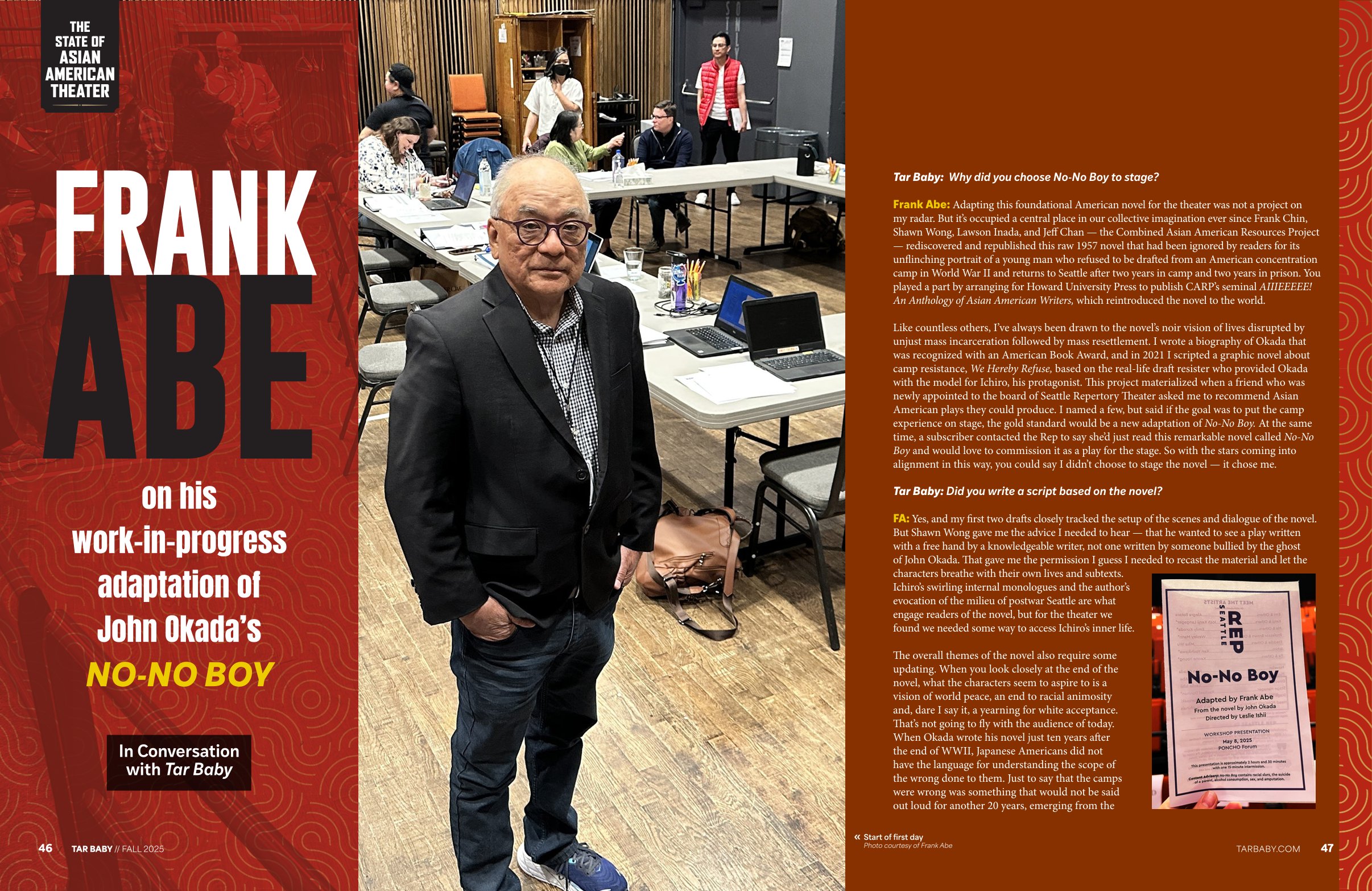
Many thanks to renowned novelist Ishmael Reed for the Q and A below. I encourage you to get a copy of the Fall 2025 issue here, just to see the world-class magazine design by Gisela Swift of Picante Creative that uses photos from our recent script workshop at the Seattle Repertory Theater. You can click on the images to read the spread, but I’ve also posted the text below:
TAR BABY
Issue #3 – Fall 2025
THE STATE OF ASIAN AMERICAN THEATER:
FRANK ABE on his work-in-progress adaptation of John Okada’s NO-NO BOY – In Conversation with Ishmael Reed for Tar Baby
Tar Baby: Why did you choose No-No Boy to stage?
Frank Abe: Adapting this foundational American novel for the theater was not a project on my radar. But it’s occupied a central place in our collective imagination ever since Frank Chin, Shawn Wong, Lawson Inada, and Jeff Chan – the Combined Asian American Resources Project – rediscovered and republished this raw 1957 novel that had been ignored by readers for its unflinching portrait of a young man who refused to be drafted from an American concentration camp in WW2 and returns to Seattle after two years in camp and two years in prison. You played a part by arranging for Howard University Press to publish CARP’s seminal AIIIEEEEE! An Anthology of Asian American Writers, which reintroduced the novel to the world.
Like countless others, I’ve always been drawn to the novel’s noir vision of lives disrupted by unjust mass incarceration followed by mass resettlement. I wrote a biography of Okada that was recognized with an American Book Award, and in 2021 I scripted a graphic novel about camp resistance, We Hereby Refuse, based on the real-life draft resister who provided Okada with the model for Ichiro, his protagonist. This project materialized when a friend who was newly appointed to the board of Seattle Repertory Theater asked me to recommend Asian American plays they could produce; I named a few, but said if the goal was to put the camp experience on stage, the gold standard would be a new adaptation of No-No Boy. At the same time, a subscriber contacted the Rep to say she’d just read this remarkable novel called No-No Boy and would love to commission it as a play for the stage. So with the stars coming into alignment in this way, you could say I didn’t choose to stage the novel, it chose me.
Tar Baby: Did you write a script based on the novel?
FA: Yes, and my first two drafts closely tracked the setup of the scenes and dialogue of the novel. But Shawn Wong gave me the advice I needed to hear – that he wanted to see a play written with a free hand by a knowledgeable writer, not one written by someone bullied by the ghost of John Okada. That gave me the permission I guess I needed to recast the material and let the characters breathe with their own lives and subtexts. Ichiro’s swirling internal monologues and the author’s evocation of the milieu of postwar Seattle are what engage readers of the novel, but for the theater we found we need some way to access Ichiro’s inner life.
The overall themes of the novel also require some updating. When you look closely at the end of the novel, what the characters seem to aspire to is a vision of world peace, an end to racial animosity and, dare I say it, a yearning for white acceptance. That’s not going to fly with the audience of today. When Okada wrote his novel just ten years after the end of WW2, Japanese Americans did not have the language for understanding the scope of the wrong done to them. Just to say that the camps were wrong was something that would not be said out loud for another twenty years, emerging from the demand for redress and reparations. Today, what the audience sees is an America that is kidnapping immigrants off the streets and trafficking them to prisons in El Salvador, as a prelude to building 21st century American concentration camps here at home. These same themes of arresting immigrants ineligible for citizenship, of incarcerating people on the basis of race regardless of citizenship, and of inducing voluntary self-deportation among the targeted people – these are embedded in the obstacles that the characters in No-No Boy must overcome. My work now is teasing out and elevating those ideas in the play in a way that is truthful both to the 1940s and to today.
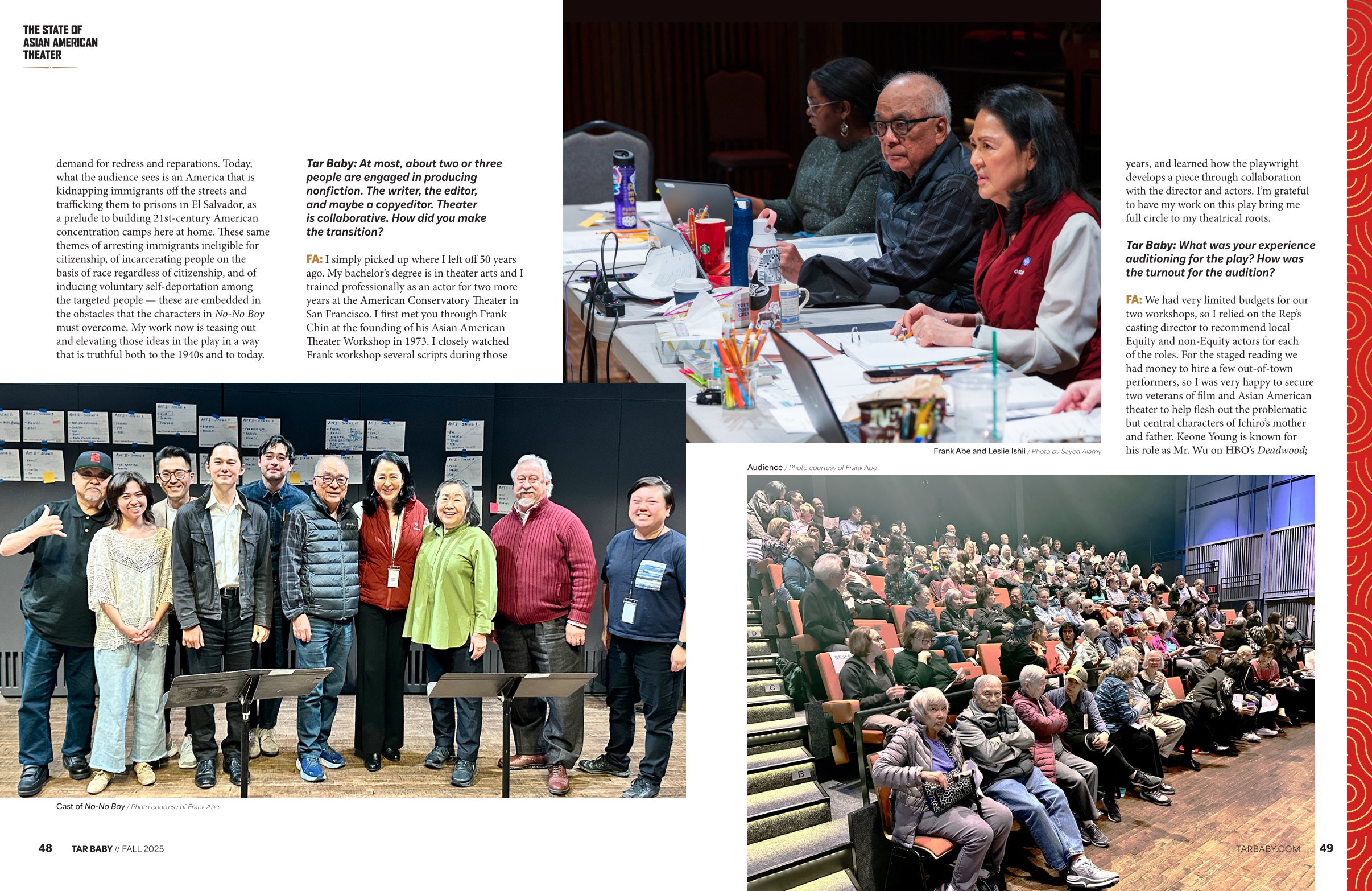
Tar Baby: At most, about two or three people are engaged in producing non-fiction. The writer, the editor, and maybe a copy editor. Theater is collaborative. How did you make the transition?
FA: I simply picked up where I left off fifty years ago. My bachelor’s degree is in theater arts and I trained professionally as an actor for two more years at the American Conservatory Theater in San Francisco. I first met you through Frank Chin at the founding of his Asian American Theater Workshop in 1973. I closely watched Frank workshop several scripts during those years, and learned how the playwright develops a piece through collaboration with the director and actors. I’m grateful to have my work on this play bring me full circle to my theatrical roots.
Tar Baby: What was your experience auditioning for the play? How was the turnout for the audition?
FA: We had very limited budgets for our two workshops, so I relied on the Rep’s casting director to recommend local Equity and non-Equity actors for each of the roles. For the staged reading we had money to hire a few out-of-town performers, so I was very happy to secure two veterans of film and Asian American theater to help flesh out the problematic but central characters of Ichiro’s mother and father. Keone Young is known for his role as Mr. Wu on HBO’s Deadwood; he and the actor Mako tried unsuccessfully to get the stage rights to No-No Boy in the 1980s, so this was a full-circle moment for him too. Emily Kuroda was welcomed back to the Rep after a recent appearance on their main stage.
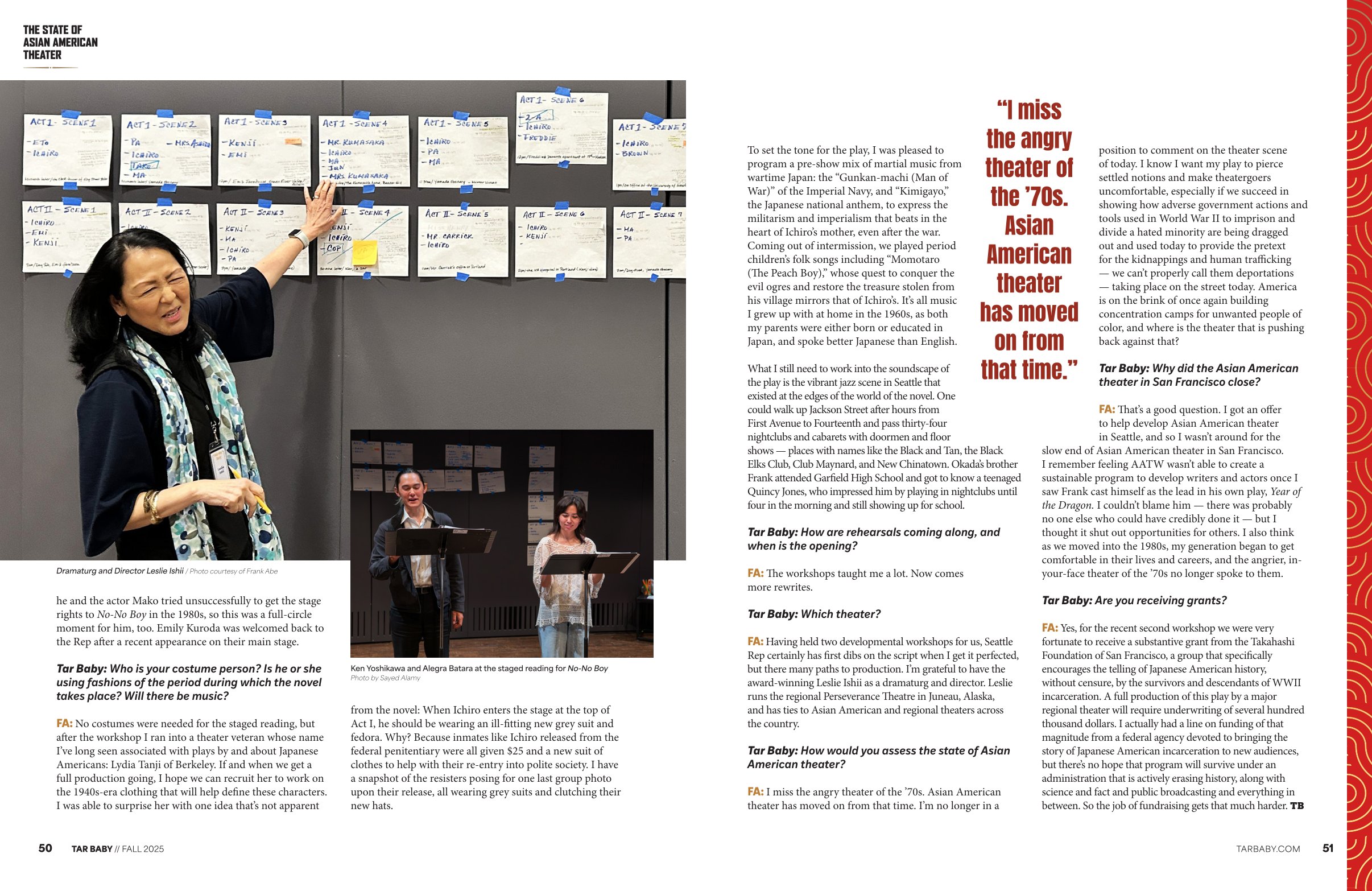
Tar Baby: Who is your costume person? Is he or she using fashions of the period during which the novel takes place? Will there be music?
FA: No costumes were needed for the staged reading, but after the workshop I ran into a theater veteran whose name I’ve long seen associated with plays by and about Japanese Americans – Lydia Tanji of Berkeley. If and when we get a full production going I hope we can recruit her to work on 1940s-era clothing that will help define these characters. I was able to surprise her with one idea that’s not apparent from the novel: when Ichiro enters the stage at the top of Act I, he should be wearing an ill-fitting new grey suit and fedora. Why? Because inmates like Ichiro released from the federal penitentiary were all given $25 and a new suit of clothes to help with their re-entry into polite society. I have a snapshot of the resisters posing for one last group photo upon their release all wearing grey suits and clutching their new hats.
To set the tone for the play I was pleased to program a pre-show mix of martial music from wartime Japan: the “Gunkan-machi (Man of War)” of the Imperial Navy, and “Kimigayo,” the Japanese national anthem, to express the militarism and imperialism that beats in the heart of Ichiro’s mother even after the war. Coming out of intermission, we played period children’s folk songs including “Momotaro (The Peach Boy),” whose quest to conquer the evil ogres and restore the treasure stolen from his village mirrors that of Ichiro’s. It’s all music I grew up with at home in the 1960s as both my parents were either born or educated in Japan, and spoke better Japanese than English.
What I still need to work into the soundscape of the play is the vibrant jazz scene in Seattle that existed at the edges of the world of the novel. One could walk up Jackson Street after hours from First Avenue to Fourteenth and pass thirty-four nightclubs and cabarets with doormen and floor shows, places with names like the Black and Tan, the Black Elks Club, Club Maynard, and New Chinatown. Okada’s brother Frank attended Garfield High School and got to know a teenaged Quincy Jones, who impressed him by playing in nightclubs until four in the morning and still showing up for school.
Tar Baby: How are rehearsals coming along, and when is the opening?
FA: The workshops taught me a lot. Now comes more rewrites.
Tar Baby: Which theater?
FA: Having held two developmental workshops for us, Seattle Rep certainly has first dibs on the script when I get it perfected, but there are many paths to production. I’m grateful to have the award-winning Leslie Ishii as a dramaturg and director. Leslie runs the regional Perseverance Theatre in Juneau, Alaska, and has ties to Asian American and regional theaters across the country.
Tar Baby: How would you assess the state of Asian American theater?
FA: I miss the angry theater of the 70s. Asian American theater has moved on from that time. I’m no longer in a position to comment on the theater scene of today. I know I want my play to pierce settled notions and make theatergoers uncomfortable, especially if we succeed in showing how adverse government actions and tools used in World War II to imprison and divide a hated minority are being dragged out and used today to provide the pretext for the kidnappings and human trafficking – we can’t properly call them deportations – taking place on the street today. America is on the brink of once again building concentration camps for unwanted people of color, and where is the theater that is pushing back against that?
Tar Baby: Why did the Asian American theater in San Francisco close?
FA: That’s a good question. I got an offer to help develop Asian American theater in Seattle and so I wasn’t around for the slow end of Asian American theater in San Francisco. I remember feeling AATW wasn’t able to create a sustainable program to develop writers and actors once I saw Frank cast himself as the lead in his own play, Year of the Dragon. I couldn’t blame him, there was probably no one else who could have credibly done it, but I thought it shut out opportunities for others. I also think as we moved into the 1980s, my generation began to get comfortable in their lives and careers and the angrier, in-your-face theater of the 70s no longer spoke to them.
Tar Baby: Are you receiving grants?
FA: Yes, for the recent second workshop we were very fortunate to receive a substantive grant from the Takahashi Foundation of San Francisco, a group that specifically encourages the telling of Japanese American history, without censure, by the survivors and descendants of WWII incarceration. A full production of this play by a major regional theater will require underwriting of several hundred-thousand dollars. I actually had a line on funding of that magnitude from a federal agency devoted to bringing the story of Japanese American incarceration to new audiences, but there’s no hope that program will survive under an administration that is actively erasing history, along with science and fact and public broadcasting and everything in between. So the job of fundraising gets that much harder.