 Obscured in much of this week’s news coverage of the passing of Gordon Hirabayashi is the fact that Gordon was not only a Constitutional test case, he was a Nisei draft resister like the Heart Mountain boys. His case, along with those of Fred Korematsu and Min Yasui, was opposed by the wartime Japanese American Citizens League because, as Mike Masaoka puts it on our DVD, “they were criminal cases,” and JACL favored its own civil habeas corpus case fronted by the irreproachable Mitsuye Endo. Listen to how Mike explains it in our bonus DVD audio feature, “Masaoka on test cases.” Read the New York Times obituary.
Final DVD artwork
All of the new DVD artwork is now posted in our Online Press Kit for viewing and download. Still waiting for the empty cases to arrive from New Jersey before the factory can cut the inserts and assemble the packages. In the meantime, here are samples of the labels and the inserts, which if you click on and enlarge, will show you details of all the bonus features on both discs.
 |
 |
|
|
Front cover
|
Back cover
|
Scene selection menu
|
 |
|
|
|
Outtakes menu
|
Interviews menu
|
Disc One label
|
 |
||
|
Disc Two label
|
Disc One insert
|
Disc Two insert
|

Preview of DVD casewrap and menu screens
 Thanks to the 144 of you who have up to this moment Liked our new page on Facebook and are visiting here for the first time. We’re gearing up for delivery of the finished DVD’s. The discs are replicated and labeled, the artwork for the casewrap and insert has been perfected and in the hands of the production house for printing and cutting, and the flip-tray clamshell cases are on order. All that remains is for the assembly of the pieces into the cases and the final shrink-wrap. And the shipments. We have several pre-orders to fill plus those who were promised DVD’s with their VHS orders over these last few months; we thank you for your patience and believe the wait will be worth it.
 The casewdrap design for the DVD is shown here. Click on the image to examine the text and design in closeup. Also to the right is the design for the Outtakes menu on Disc One, which you can click on and enlarge to preview the titles of the 11 new outtakes.
In memoriam: Noboru Taguma
 I’m very saddened to learn of the passing last week of Noboru “Elmer” Taguma of the Sacramento area. Noboru was one of the early resisters from the American concentration camp at Amache, Colorado, aka the Grenada Relocation Center. He’s also the father of Nichi Bei Weekly editor Kenji Taguma, to whom we send our deepest condolences.
Noboru was a great guy, quick to laugh and always with a sly smile on his face. He provides an impish comment that caps one of the bonus features on our forthcoming DVD. I don’t want to spoil the moment, you will soon be able to see for youself.
Kenji posted more details about his father, along with the photo of him that appears near the end of our film:
TAGUMA, NOBORU, 87, passed away peacefully at his home in West Sacramento, Calif. on March 11, 2011. A native of Broderick, Calif. who was born on April 3, 1923, he retired in the early 1990s after farming tomatoes for 45 years, mostly for Campbell’s Soup, around Clarksburg, Yolo County, Calif.
During World War II, he was one of only 300 young Nisei to resist a military draft imposed behind barbed wire, based upon constitutional principle. He stated he would gladly fight for his country if his family was released from the wartime concentration camps and his citizenship rights were restored. Once shunned by so-called “community leaders,” the resisters today are heralded for the civil rights stand they took….
He is survived by his beloved wife of nearly 53 years, Sakaye (Yoshizawa) Taguma; daughter Masako Carol Yasue of Nagoya, Japan; son Makoto Mark (Alice) Taguma of Mountain View, Calif.; daughters Mariko Sharon (Benjamin Kam) Taguma of Union City, Calif. and Machiko Gail (Andy) Irie of Torrance, Calif.; and son Kenji Glenn Taguma of San Francisco. …
Final Viewing will be held on Thursday, April 7, 6 to 8 p.m., at Sacramento Memorial Lawn, 6100 Stockton Blvd. in Sacramento.
A Memorial Service will be held on Saturday, April 9, 1:30 p.m., at Sacramento Memorial Lawn, with burial to immediately follow. Reception afterwards at the Tenrikyo Sacramento Church, 6361 25th Street (at 47th Avenue) in Sacramento.
In lieu of flowers, donations in his memory can be made to the Nichi Bei Foundation, P.O. Box 15693, San Francisco, CA 94115.
N.Y. Times obit for Frank Emi
Calling Frank Emi “defiant,” the New York Times takes note. Reprinted in the San Francisco Chronicle.
The phrase he heard among the detainees was “Shikata ga nai” – it can’t be helped …
For Mr. Emi, the mantra became “No more shikata ga nai.”
At Frank Emi’s memorial service
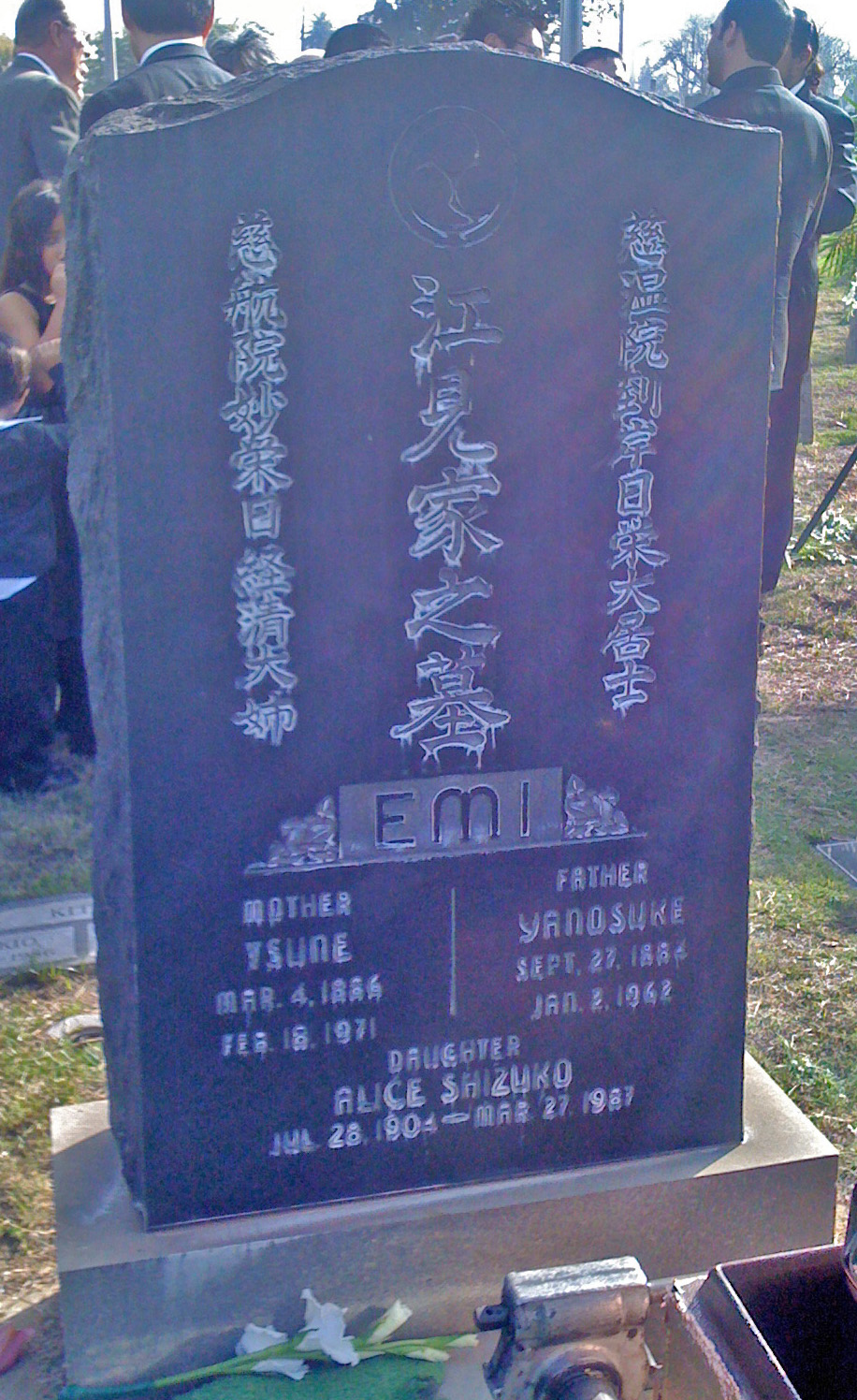
Frank Emi was buried Friday at Evergreen Cemetery in East Los Angeles. He comes to rest just several hundred yards from the paupers’ grave where the founder of the Heart Mountain Fair Play Committee, Kiyoshi Okamoto, is interrred. Together they made history, and it fitting that their lives and legacies remain intertwined to the end.
Frank goes to his final rest dressed in his white judo gi, a Buddhist ojuzu prayer bracelet wrapped around his left hand and his judo medals set next to him. More than 250 mourners attended his service at Nichiren Buddhist Temple for an hour of sutra chanting.
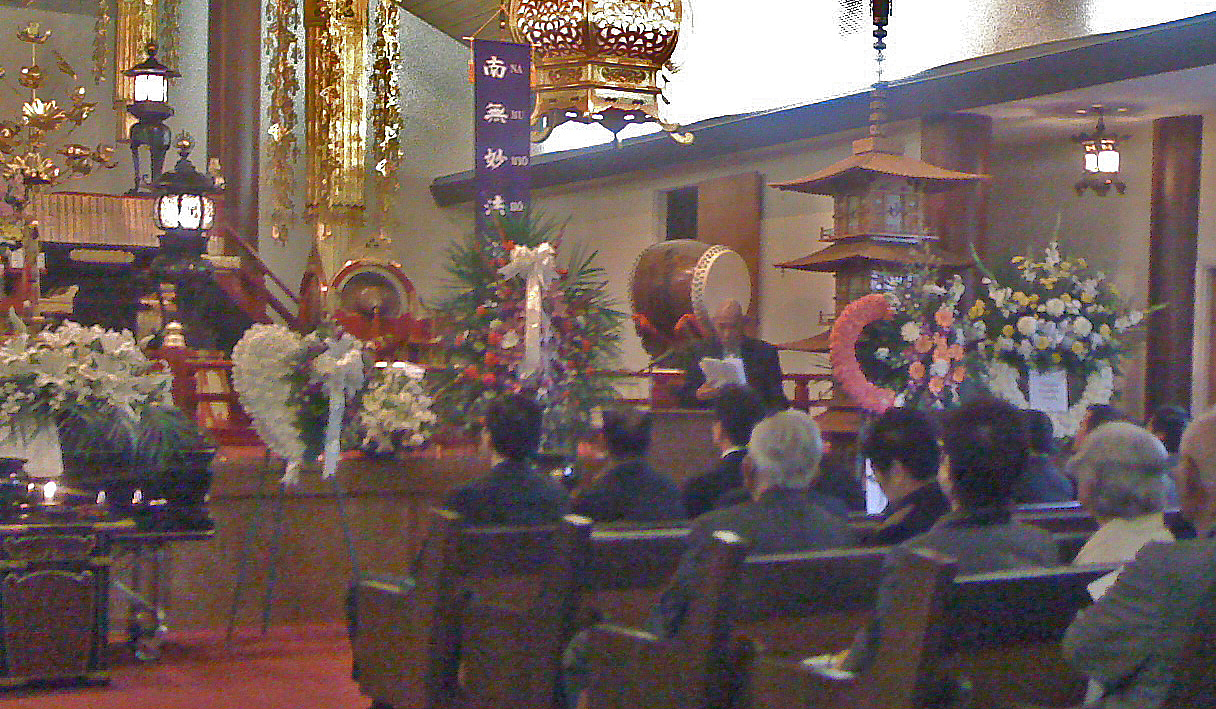 For his eulogy, writer Frank Chin announced “Superman is dead!” He then drew chuckles reading an excerpt from his book, Born in the USA. You can follow along, it’s the “Brothers and Sisters” exchange between Frank, brother Art, and sister Kaoru on pages 163 to 166.
Bob Iwasaki from the Hollywood Judo Dojo knew Frank as “Emi-sensei.” Heart Mountain resister Yosh Kuromiya had this:
Frank Seishi Emi was a fighter. The word “retreat” was not in Frank’s vocabulary. He and he alone, would decide when it was time to move on. Sadly, that time has arrived. Read more…
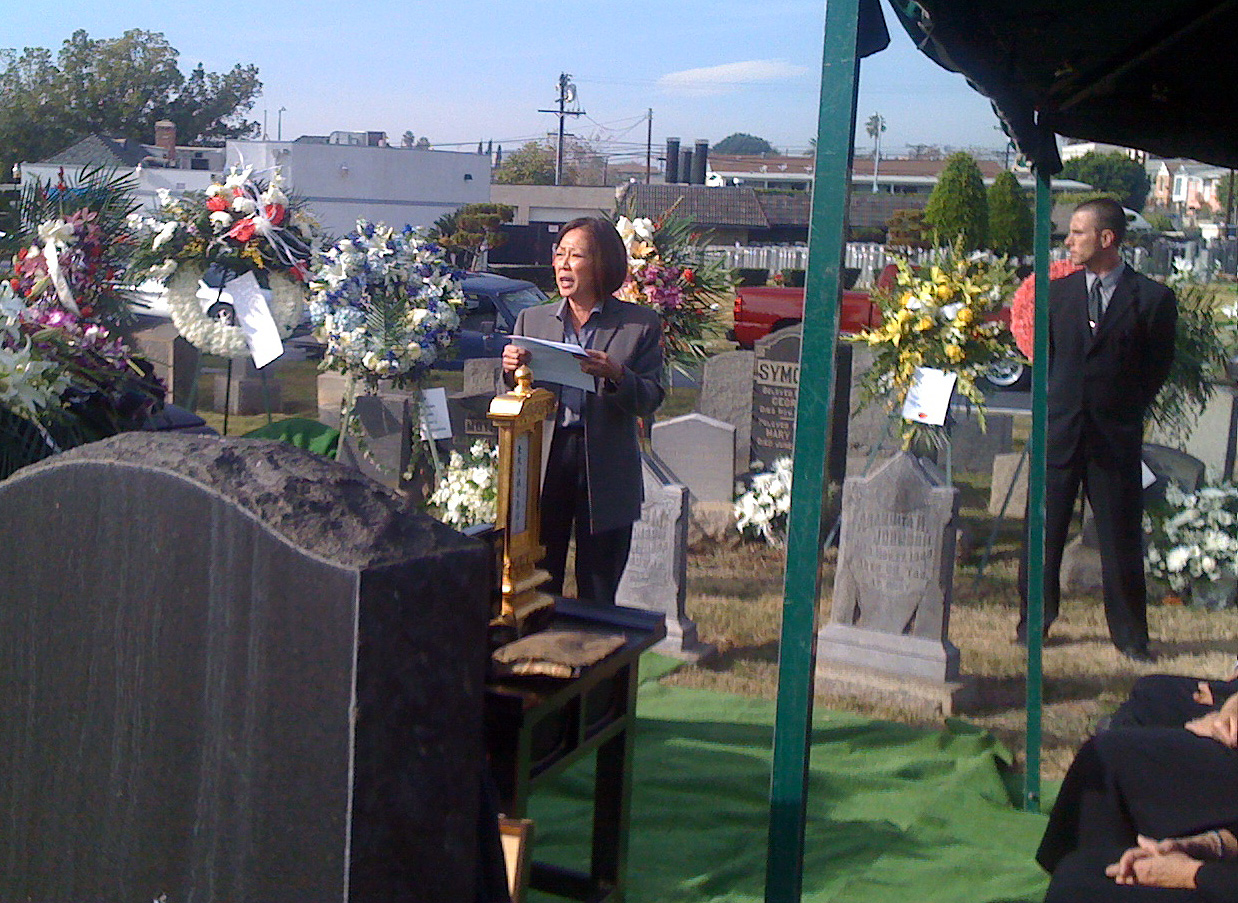 At the interment service at Evergreen, actress and soon-to-be filmmaker Momo Yashima gave a dramatic reading at the gravesite.
The Los Angeles Times published a thoughtful and prominent obituary for Frank Emi on page B-1 of their local section, conferring on him the honor he deserves.
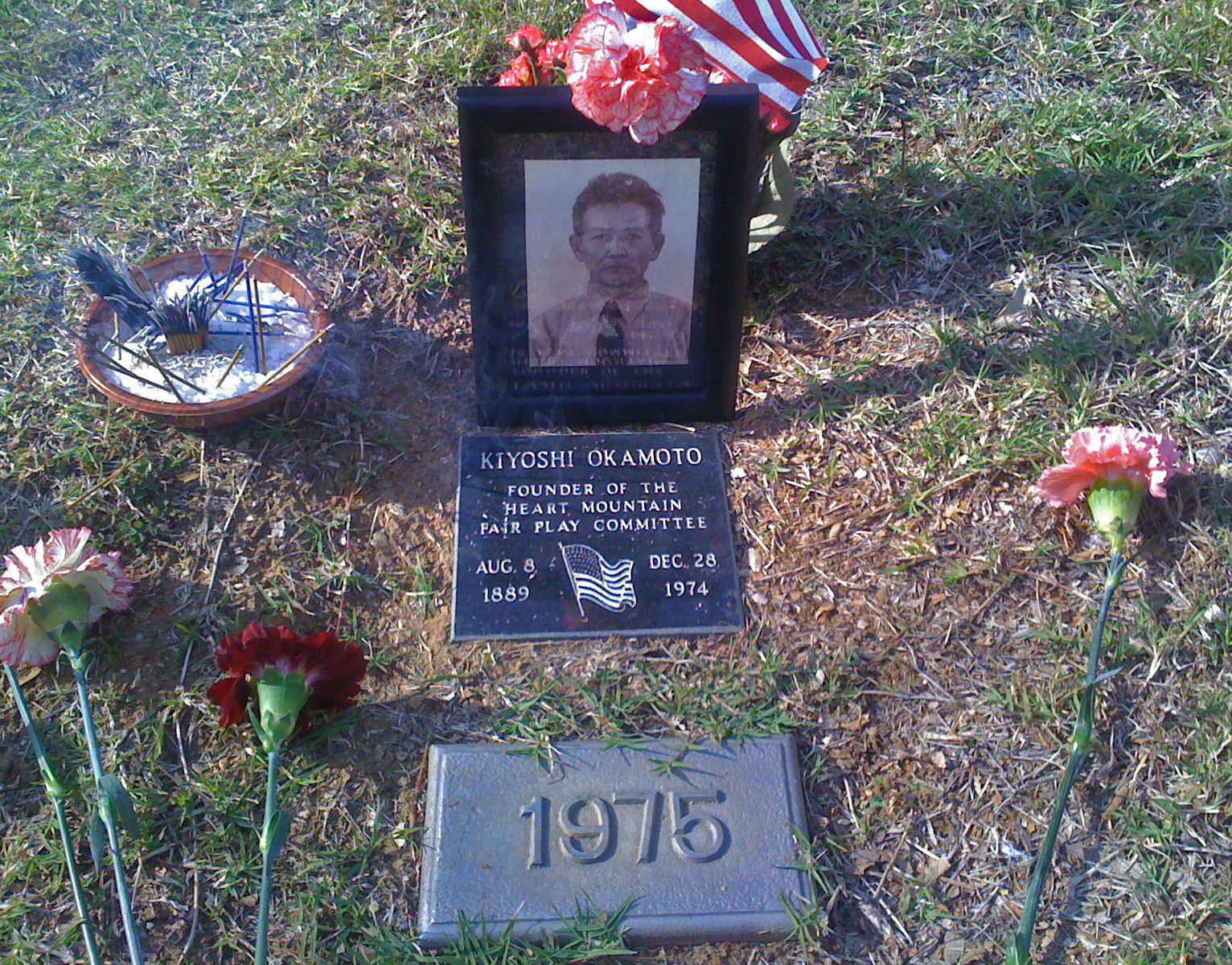 Before we left for the reception, a few of us adjourned to the adjacent “Potter’s Field” section of Evergreen Cemetery, where we lit incense at the recently installed marker for FPC founder Kiyoshi Okamoto. Relative Marie Masumoto located Okamoto’s remains last year in a mass grave for paupers from the year 1975, and a ceremony was held to dedicate the new marker. On this day Okamoto’s great-nephew Earnest Masumoto read some new remarks on the occasion of Frank Emi’s passing. And from our discovery of the resisters, we’ve come full circle to the interment of both leaders in the same city, in the same cemetery.
Rafu Shimpo obit for Frank Emi
 Martha Nakagawa has published a thorough remembrance of the life of Frank Emi in today’s Rafu Shimpo newspaper. I will be attending the memorial service this Friday in Los Angeles and hope to meet you all there. Heart Mountain resister Yosh Kuromiya will be one of the three speakers.
Frank Emi issuing a challenge to JACL
Frank Emi’s funeral will be held on Friday, Dec. 10 at 10:00 am, at the Nichiren Temple, 2801 Fourth Street, in Boyle Heights. Thanks to Martha Nakagawa for the tip. Here’s another video clip from the forthcoming DVD, Frank Emi issuing a challenge to the JACL even as the group apologizes to him and the others for persecuting them during the war.
In memoriam: Frank Emi
These are the words I have long dreaded having to write: Frank Emi died today. We’ve lost a giant. That’s him in the poster above, standing squarely with his arms crossed, defying the government and our own Japanese American leadership, by organizing a movement inside an American concentration camp to refuse to report for draft induction in order to protest mass incarceration based solely on race. It was an honor to know him and to be able to document his story on film. Here’s an outtake from our film of Frank descibing how he and the other Fair Play Committee leaders earned the respect of other inmates and officials inside Leavenworth federal penitentiary in WW2.
Frank Emi was a man 40 years ahead of his time. He was an ordinary young man, but a man of conviction who rose to the occasion when faced with the injustice of the camps. With a wife and two kids he was not even eligible to be drafted out of camp, but he risked his freedom and the welfare of his family to help lead the largest organized resistance inside the camps. It was a classic example of civil disobedience in the American twentieth century, and he and others paid the prce: two years in federal prison.
By his words and his deeds, Frank Emi leaves a legacy for those who seek evidence that Japanese America did not endure the loss of all their rights, and three years in camp, without some kind of protest or resistance.
Martha Nakagawa warned me that Frank had recently been taken to the ICU. She was gracious enough to bring her portable DVD player to the hospital and play Frank this clip and other outtakes from the film. I’m glad he was able to see the work and know that a DVD is soon coming out. Martha said Frank was moved to a hospice last Saturday. It is still sinking in that Frank is gone. Rest in peace Frank, and thanks for marking your place in Japanese American history.
Newspaper obits for William Hohri
 Thirty years ago, William Hohri picked up our Days of Remembrance movement here in Seattle and took us national. William’s memorial service was today in Little Tokyo. Nice of Elaine Woo at the L.A. Times to call and ask for a quote. Martha Nakagawa offers exhaustive coverage of William’s life and times in the Rafu Shimpo, and she still says she feels bad that she wasn’t able to include William’s earlier life in the Shonien and Manzanar’s Children’s Village.