The legacies of journalist James Omura and the Heart Mountain Fair Play Committee live on in two new museum exhibits opening this month in Washington, DC and Seattle.
On May 16, the Newseum, in partnership with the Smithsonian Institution, opened “One Nation With News for All,” an exhibition on the origins and influence of the ethnic media in the U.S. One section discusses free speech during WWII, specifically highlighting this photo of James Omura as the editor of Denver’s Rocky Shimpo, with this description:
Fighting for Free Speech During World War II
Shortly after the Japanese attacked Pearl Harbor in 1941, more than 100,000 Japanese Americans living on the West Coast were forced into internment camps by the U.S. government. Despite this, the men in the camps were still called up for American military service. James Omura, editor of Denver’s Rocky Shimpo newspaper for Japanese Americans, risked jail by publishing stories about a draft resistance movement at a Wyoming internment camp. Charged with conspiracy to counsel draft evaders, Omura was acquitted on free speech grounds.
The Omura photo is also used on an interactive kiosk featuring 100 pioneering ethnic media outlets from Colonial America to today. Visitors can touch the map and find out more about those news organizations.
The mission of the Newseum in Washington, DC, is to champion the five freedoms of the First Amendment through education, information and entertainment. It blends news history with technology and hands-on exhibits. “News for All” will be on display there through Jan. 4, 2015.
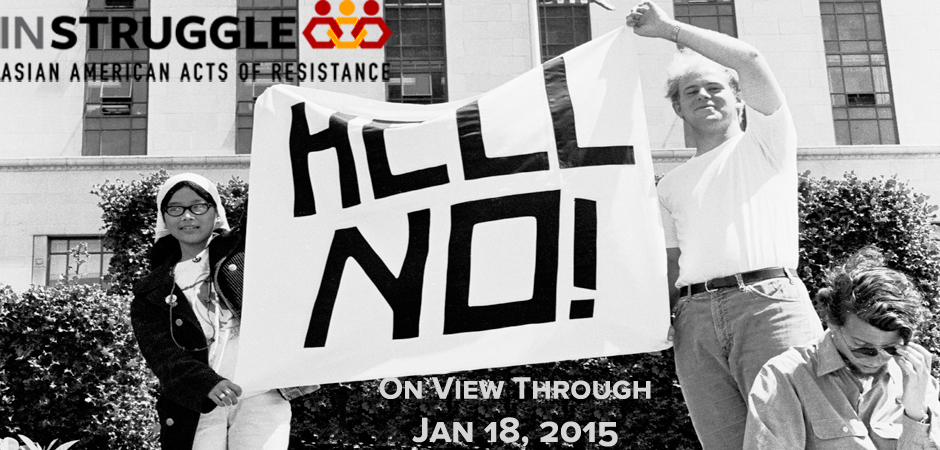
The mug shot of Frank Emi at Leavenworth is included in the program for a new exhibit in Seattle’s Wing Luke Museum of the Asian Pacific Experience, “In Struggle: Asian American Acts of Resistance.” We uncovered the prison mug shot in time for inclusion on the menu animation for Disc Two of our DVD. The exhibit is on view through January 18, 2015.
Seattle jazz artist Stephen Griggs is staging a series of music and spoken word concerts at the Panama Hotel Tea Room, based on the history of Japanese Americans in Seattle. The project is inspired by the music of Oscar Holden and the novel Hotel on the Corner of Bitter and Sweet. But he was also reading John Okada’s No-No Boy and says “the powerful feelings and stories told by Okada will influence my project.” Also this:
I want you to know that your film Conscience and the Constitution served as an inspiration for my Panama Hotel Jazz project.
So many camp stories sound conciliatory and driven by fate. This film told stories of resistance and agency. I am not of Japanese ancestry and the film’s perspectives felt less alien to me. That opened a door for me to develop my project from a stance of civil injustice which is common ground for all Americans.
Two more free concerts in the series remain, at 2pm Saturday September 14 and 21. The Panama is located at 607 South Main Street in the International District. The project is funded by the 4Culture Historic Site Specific program.
Also inspired was Rob Hellebrand, who sent a nice note along with a paper he wrote entitled, “Nisei Divided: An Account of the Fair Play Committee at the Heart Mountain, Wyoming Internment Camp.”
I have really enjoyed looking through the resources at your website. I happened to first come upon it in 1999 when I was writing a paper for a class. I knew relatively little about the internment camps and wanted to know more, and just kind of fell into the story that you told there. This was when the DVD was still in production, so I only had the documents that you uploaded to go by.
About five years later, I attended a symposium about the resisters at the University of Oregon. I remember I was at the food table and I looked up and recognized Frank Emi from sixty-year-old pictures. He seemed surprised that I would know who he was.
Tak Hoshizaki at the “Standing on Principle” panel, July 6, 2013. Photo by Tracy Kumono Photography.
Tak Hoshizaki is one of the few surviving Heart Mountain resisters who continues to speak in public. At the Japanese American National Museum national conference on July 6, in a panel called “Standing on Principle,” Tak shared his first-hand account of the growing Fair Play Committee movement at Heart Mountain in 1944, and we thank him for allowing us to share it with you:
“KIYOSHI OKAMOTO AND THE FOUR FRANKS”
Kiyoshi Okamoto
“Fair play, fair play, civil rights, fair play” was what Kiyoshi Okamoto was saying as he talked to anyone who would listen in the cold, windy Wyoming concentration camp. Ten-thousand Japanese, most of them American citizens, held in a concentration camp in a desolate part of Wyoming, had little understanding of how their civil rights were violated. Kiyoshi was trying to tell the inmates that the United States government, their country, had wrongly imprisoned them. As he spoke to small groups, Kiyoshi called himself the “Fair Play Committee of One.”
In the winter of 1942-43, the Army came into Heart Mountain to recruit volunteers. This was the same time the infamous loyalty questionnaire with question 27 and 28 was being debated.
Frank Inouye
We now meet the first “Frank,” Frank Inouye. At the recruiting meeting, after the Army’s presentation, Inouye presented a manifesto demanding the U. S. government restore the rights of the men before drafting them. As a result, the Heart Mountain Congress of American Citizens was formed, represented by 2 people from each block. Inouye became the chairman. Before the Congress of American Citizens had time to develop, Inouye was able to leave the camp. With Inouye gone, the congress eventually evolved into the Fair Play Committee.
As a side note, Inouye later became a professor and an administrator at the University of Hawaii. He also was the main driving force who developed the University of Hawaii campus at Hilo. A few years ago, the University of Hawaii had a dedication and recognition for Frank Inouye’s efforts that brought about the existence of the Hilo branch. Frank Inouye passed away a few years ago.
Frank Emi
We now meet the second “Frank,” Frank Emi. Emi became one of the leaders of the Fair Play Committee. Emi played a major role in the Fair Play Committee conflicts with the camp administrators.
Emi at this time was married and had a family. He was not eligible for the draft. Again like Inouye, Emi also believed that before drafting the men, their full citizenship rights be restored.
The Fair Play Committee of One became the Fair Play Committee of Many. With Frank Inouye gone, the former members of the Congress of American Citizens joined together with Kiyoshi Okamoto, Frank Emi and others to form the Fair Play Committee. The Fair Play Committee began holding meetings, discussing the questionnaire and the draft. I attended a meeting and was surprised at the wall to wall attendance. The plan was to have our civil rights returned before we would serve. Also was surprised that I was not alone in my thinking of not answering the draft call.
By this time 1943-44, I was of draft age. When I entered the Pomona Assembly Center I was 16, not very good in history and English, understood very little of the Constitution of the United States let alone an understanding of civil rights. It was there in the Pomona Assembly Center as I listened to the older Nisei talk, I learned about how we should have contested “Evacuation” by legal action. How we were betrayed by “JACL.” The Japanese American Citizens League. Who were they? How did JACL have a role? I began to realize that something was wrong. When I heard of the financial losses of many families, and that families were broken apart by the arrest, removal and detention of their fathers, I realized more than ever, our removal was wrong. While in Pomona I wrote to my homeroom teacher at Belmont High School. The letter expressed my very bitter feelings of what had happened. She answered she was sorry that I felt so angry.
Now two years later, I had decided that I would not go if called. A few weeks later I received my draft notice. I did not appear for my physical. I continued to work at the camp engineering office. One of the nisei workers approached me and told me an administrator’s son was killed by the Japanese. The nisei worker suggested that I not work there anymore to ease the pain of his loss. I stopped working.
A few days later I was picked up early in the morning. There were 63 of us. The largest Selective Service trial on record. We hoped that the publicity of the trial would help in the return of our civil rights, release from camps and return to our homes, our neighborhood.
We, the 63, decided for a trial by a judge only. The idea was that with the war on, members selected for a jury would not be sympathetic to us. A big mistake. In his book Free to Die for Their Country, Eric Muller describes the presiding judge as a racist. Strike three. In the trial, failure to report for the draft was only considered. The fact that we were being drafted from a concentration camp was not brought up. Only that we had broken the Selective Service Act. We were found guilty and given a 3 year sentence to serve in a Federal Penitentiary.
The leaders of the Fair Play Committee were later arrested, found guilty of conspiracy to violate the Selective Service Act and sentenced to 4 years in the Leavenworth Federal Penitentiary. They appealed the sentence and won. They served about 18 months. In 1947, President Truman pardoned all the Nisei draft resisters. All of us, the Fair Play Committee members and the resisters, now had our full citizenship back. The records of our imprisonment erased. We were now regular citizens.
We all returned to civilian life, going back to school or going to work, putting aside our thoughts of these experience. Except for Emi. Frank Emi gave talks before groups and at various universities telling the story of the Fair Play Committee and the draft resistance at Heart Mountain. News media and the Japanese American community gave little note and eventually swept the story “under the rug,” giving little mention of the resistance. We were written out of the Japanese American history. Our story of draft resistance to regain our civil rights buried and forgotten.
I continued my education and was studying for my master’s degree at UCLA when the Korean Conflict started. I was young enough and soon found myself drafted and in the Army. I personally know of five other Heart Mountain resisters who like myself later served. The age limit was 28 so only the youngest of the resisters were still eligible for the draft. We had our civil rights returned, our families were now out of the concentration camps. As we stated as our stand during the trial, give back our civil rights and release our families and we will gladly serve.
The story of the Fair Play Committee was seldom if ever mentioned in the vernacular papers, let alone the regular press. The exploits of the 442 were broadly and repeatedly publicized and rightly so. The Fair Play Committee was now a forbidden topic. Swept under the rug. Written out of history. The resisters, we were the bad guys.
Frank Chin
We now meet the third “Frank.” Frank Chin, a Chinese American, an outspoken playwright, novelist, and writer. Chin apparently discovered / uncovered the story of the Fair Play Committee and the Heart Mountain draft resisters and wrote in his typical manner about the Fair Play Committee and the resisters. Chin obtained copies of reports and documents on Heart Mountain, those that were written by the administrators. Chin published “The Organized Resistance” in the annual special edition of the Rafu Shimpo in December of 1981. Chin wrote a very in-detail, documented history of the Heart Mountain Fair Play Committee.
With this story, Chin was instrumental in bringing to light the resister story. Chin’s exposé answered the question put forth by the younger Japanese Americans, “Why didn’t you resist?” We did resist but our actions were never told. Chin has supported and written much on the resister’s story.
Frank Abe
Now we meet our fourth “Frank,” Frank Abe. Frank had also wondered, “Why didn’t you resist?” When Abe learned about the resisters, he set out on a long 20-year plus journey that culminated in the famous documentary film Conscience and the Constitution. He spent many hours tracking down and interviewing the surviving resisters. Abe’s question for the Japanese Americans now is, “Why did you turn your back on those who resisted?”
We are now meeting in Seattle, Frank Abe’s present home town. Thank you all for being here and for your kind attention. Kokoro kara.
Thanks again to Tak Hoshizaki for sharing his remarks. He’s been quoted in a few books about the resistance, but we hope he continues to write about the FPC in his own words.
In support of our film being featured on Comcast XFINITY video-on-demand this month, Cinema Asian America curator Chi-hui Yang conducted this online interview for their TV Blog. I told him his questions were among the most thoughtful I’d ever been posed. See what you think:
Interview: ‘Conscience and the Constitution’: Talking with Frank Abe
by Chi-hui Yang | May 2, 2013 at 2:44 AM
The history of Japanese American internment is a complex one and reveals many deep contradiction and divisions both within America, and more specifically, the Japanese American community. You chose to focus on the latter in “Conscience and the Constitution” noting that in 1944, the draft resisters at the Heart Mountain Relocation Camp in Wyoming “served two years in prison, and for the next fifty were written out of the popular history of Japanese America.” What were the stakes for you as a journalist, and a Japanese American when you decided to dig deep into this contested history?
FA: I never bought into the idea that Japanese America’s only response to this massive violation of constitutional rights was passive resignation – shikatagai, Japanese for “it can’t be helped” – or patriotic self-sacrifice as embodied by the Nisei soldiers and go for broke! But as a baby boomer born after the camps, if you asked, “gee, why didn’t you guys contest this?” you’d get a pat on the head and told that “you weren’t there, times were different, you can’t judge us with your Berkeley civil-rights activism of the Sixties.” So when I first learned of the organized resistance at Heart Mountain, which incidentally was my father’s camp, I felt like I’d found a missing link. And the more we scripted out the story, the more we could see that it would shift the paradigm of Japanese American history and show that besides cooperation and collaboration, there was protest and resistance.
Here was a classic example of civil disobedience in the American 20th century, but it threatened the party line and the popular narrative of victimization. That made it critical to me as a journalist that we get the story right and tell it fairly, to document an unassailable case, and to get it into the marketplace with the legitimacy conferred by a presenter like PBS. It must have worked because none of the dismissive “old guard” really pushed back – well, maybe one, and he can be seen near the end of the film.
Most meaningful to me was that the film provided the historical context and framework through which the children of the resisters could finally understand what their fathers and mothers did. Many of these people my age had gone through life feeling vaguely uneasy about their fathers’ time in a federal penitentiary. When they saw that there was no community backlash to the film, and instead a large audience for the recovery of this untold story, they could see that their fathers were in fact principled people who acted in the best American tradition.
You’ve said that this film in many ways, would have been very difficult to make before the Civil Liberties Act of 1988, in which the US government gave reparations to Japanese Americans who were interned during WWII. Why?
FA: Because without an accepted foundation of verified fact, anything we put out there would have been too easily dismissed as opinion or hearsay. I was jolted into action to help kick-start the redress campaign when writer Frank Chin literally came to my door and said, “If you lose Japanese American history, you can kiss Japanese American art goodbye.” At that time in 1978 every attempt to raise the issue of injustice in the newspaper or on the radio was greeted with letters to the editor and callers on the air who would snarl, “yeah, but don’t forget these guys bombed Pearl Harbor,” or “don’t forget they were put in camp for their own protection.” Whenever Frank Emi spoke in classrooms he had to bring armloads of books and court cases to first prove the case against the camps before he could begin to talk about the Fair Play Committee. Frank Chin showed us that by staging events like the first Days of Remembrance in Seattle and Portland, we could use the media to get across the simple message that the camps were wrong, and that paved the way for the first redress bills in Congress.
While pursuing redress over the next ten years, we had to show a united front with the Japanese American Citizens League (JACL) and others. We couldn’t muddy the argument by bringing up the cooperation of JACL leaders in the eviction from the West Coast and administration of the camps, or the resistance to the draft at Heart Mountain and other camps. Once we held the government accountable for redress in 1988, we were freed to turn to holding our own leaders accountable, a movement that climaxed with the events seen at the end of Conscience.
And are there still lingering histories of the internment which have not been told which future generations of filmmakers should uncover?
FA: It’s harder now with each passing year, but there needs to be an authoritative study of the false distinctions between loyalty and disloyalty that were forced upon us by the wartime government and internalized by our own community – the no-no’s, the renunciants and the expatriates. Whether by intent or incompetence, these expressions of dissent were driven by administrators who effectively created disloyalty, anger and alienation through the implementation of loyalty oaths and segregation of families based upon their answers.
“Conscience and the Constitution” was made more than a decade ago and you’ve remained very active in screening it and making it available in classrooms. How can we connect up the history you examine in the film, with current conversations and politics in the US?
FA: The unjust eviction and incarceration of Japanese Americans based solely on their race is the single largest precedent that inhibits the power of the federal executive to profile populations on the basis of race, ethnicity and religion. We saw that in play right after 9/11, when the knee-jerk hostility and calls for roundup of Arab Americans were tempered by the acknowledgment that America made this mistake after Pearl Harbor. As historian Eric Muller put it, our memory is a precious resource in the fight against racism and scapegoating, and it’s one to which we bear special witness.
On the cultural scene, the specific story we frame of the wartime JACL’s promotion of military service and its suppression of the Heart Mountain draft resistance has found unexpected life in actor George Takei’s legacy project, a musical called Allegiance. The show premiered last fall in San Diego with aspirations for a Broadway run, and while there are certain issues with the script, which is still in development, it has certainly kept this story in front of a national audience.
You’ve been deeply involved in Asian American culture and politics for more than three decades, as a journalist covering the community, as a founding member of the Asian American Theater Company, and as a filmmaker. What was the starting point for you and what excites you about Asian America today?
FA: Coming out of college my imagination was captured by the AIIIEEEEE! Boys: the band of young writers who first proclaimed there was such a thing as an Asian American sensibility and who proved it by recovering and republishing the works of John Okada, Louis Chu and others. It was an imaginative home I never knew I had, and the works of fiction, poetry, and theater that were created were rooted in our shared history and the excitement of rediscovering a buried past.
Today I can get annoyed by the fashionable notion in some places that we’ve moved past history, past the camps, that it’s all been said and done and we’ve moved on. Then I can get excited by the emergence of former editor Naomi Hirahara as a celebrated mystery writer who can slip in references to the Fair Play Committee; or more recently the Kaya Press translation of Lament in the Night, a gritty 1925 novella written in Japanese by an Issei who authentically captures the back alleys and bathhouses of LA’s Little Tokyo before the war in a way we’ve never seen before.
What are you working on now?
FA: We’re marketing a two-disc special edition DVD of Conscience with outtakes, extensions of the interviews and new featurettes, because there was so much great material we couldn’t fit into the hour-long film. It’s a useful resource for students to enable research of the primary interviews along with the rich database of documents we put online at PBS.org/Conscience . Next is an anthology of essays that examines the postwar resettlement of Japanese America and the world into which the resisters were thrust after serving their two years in prison. That’s another lingering history that’s not been well examined, and we’ll investigate it through the lens of writer John Okada and his foundational novel, “No-No Boy.”
One of the featurettes on our new DVD, “The JACL Apologizes,” will screen in San Francisco Japantown on Monday, Feb. 18 as part of this year’s, “Films of Remembrance.”
It’s a one-day film series held in conjunction with the Bay Area Day of Remembrance, commemorating the 71st anniversary of the signing of Executive Order 9066, which set the wheels in motion to forcibly relocate some 120,000 persons of Japanese ancestry into American concentration camps during World War II. Our piece caps off the day’s program, which ends with this description:
5:30 p.m. “A Divided Community: Three Personal Stories of Resistance” (2012, 73 min.) This documentary by Momo Yashima highlights the struggles of three Japanese American World War II resisters — Yosh Kuromiya, Frank Emi and Mits Koshiyama — who challenged the U.S. government’s decision to draft Japanese Americans while they and their families were being held in America’s concentration camps.
Followed by “The JACL Apologizes” by Frank Abe, from the DVD “Conscience and the Constitution.”
The screenings are at Nihonmachi Little Friends, 1830 Sutter St. (near Buchanan) in San Francisco Japantown. The event is sponsored by the Bay Area Day of Remembrance Consortium, the Nichi Bei Weekly and the National Japanese American Historical Society. Free admission, though they’d welcome donations. Thanks to Kenji Taguma for including our piece in the series.
The Heart Mountain resisters, under the heading of “Internment Dissenters,” will be among 16 individuals and groups honored in San Francisco this Sunday at the third annual Fred Korematsu Day celebration. Thanks to the organizers for linking to this site for information about the resisters and, for the short film to be screened at the event, thanks for using two of the stills from our film: the shot of Frank Emi in camp with grocer Kozie Sakai, and the iconic courtroom photo of the 63 resisters on trial in Cheyenne, Wyoming.
The Fred T. Korematsu Institute for Civil Rights and Education is a program of the Asian Law Caucus, which was co-founded by longtime supporter and civil rights lawyer Dale Minami. The event is this Sunday, January 27, 2:30-4:30pm, at Herbst Theatre in San Francisco on 401 Van Ness Ave.
In what is billed as “a historic gathering of civil rights heroes and the descendants of heroes who have passed on,” the Nisei draft resisters are sixth on a list of 16 American civil rights heroes who organizers say have been long overlooked:
#6. INTERNMENT DISSENTERS: “No-Nos,”draft resisters and renunciants who challenged the WWII incarceration and mistreatment of Japanese Americans. ‘No-No’ Hiroshi Kashiwagi will represent this honoree group at the event.
The video to be shown is described as a 2-minute short produced by filmmaker Winnie Wong, who interviewed Hiroshi for it She hopes to be able to share a Vimeo link at some point. The Institute’s Education Coordinator, Tim Huey, writes:
We are offering 2 free VIP tickets to each living member of our honoree groups. So, for those that are a Filipino WWII veteran, Japanese American WWII veteran, Internment Dissenter (draft resister, No-No, renunciant), or Dollar Store Striker that wish to attend, have them call us at 415-848-7737 to request complimentary tickets or email [email protected]. At this point resister Jimi Yamaichi plans on coming, as well as No-No Jim Tanimoto. We’d love to have more dissenters attend if they are able.
The 16 Heroes are all featured on an educational poster that is going into our teaching kits that are sent for free to educators across the country. We’ll be unveiling the poster at the event. More information on the teaching kits can be found on our website. Most of the materials can be downloaded for instant gratification, but for those desiring a physical kit, they simply have to fill out a basic online form to request them.
Tickets for the event are . And again, Japanese American draft resisters, renunciants, and no-no boys are among those who can get free VIP tickets.
There is an episode of Star Trek in which aliens build an entire culture around a book about Chicago mobsters of the 1920s. The aliens recreate the guns, the clothes and the lingo, but it’s just a guess based on what they see in the book. The new musical Allegiance, now playing at The Old Globe in San Diego, feels a little like that, with its creators studying books, photos and websites to come up with an alternate reality for the Japanese American incarceration – one that looks like the real thing but is governed by different rules.
In the parallel world of Allegiance, the sound of bullhorns herds inmates around, female arrivals are forced to strip to their underwear at gunpoint, and military guards bearing rifles fixed with bayonets roam inside the confines of camp on an apparently daily basis – shoving unruly inmates to the ground, firing warning shots into the air to restore order, and taking more deadly aim at, of all people, the Heart Mountain resisters who are the subject of our film.
An Issei is slapped into handcuffs the instant he answers no-no to the Leave Clearance questionnaire. When his son surges forward, a private turns his rifle on him (“Back up, Jap!”). When an outraged crowd rushes the gate, a guard fires a warning shot.
Sound like the loyalty registration you or your parents remember? Of course not, because it’s a perfectly imperfect duplicate of camp, like the Bizarro World of Superman comics. It’s the incarceration as if it takes place in a German POW camp. But Heart Mountain was an American concentration camp, not Stalag 17.
Turnaround is fair play for the cast of Allegiance during a break in performance, enacting in reverse the rifle and bayonet action of the show itself. (Allegiance Facebook page)
By design, the rifles and bayonets have a visceral impact on audiences. The theatrical devices can be argued to provide an emotional shorthand for the unrelenting physical and spiritual oppression of camp, but audiences do not share a sufficient base of common knowledge about the camps to recognize the difference between fantasy and fact.
Yes, the family at the center of Allegiance is fictional, but what’s wrapped around that fiction is billed as the true story of the Japanese American experience, and that story firmly anchors itself in the non-fiction world by invoking Heart Mountain, the Heart Mountain resisters, the 442, the Japanese American Citizens League and its wartime leader, Mike Masaoka. The show establishes the terms by which it invites itself to be measured.
And in the real world that many readers of the Rafu still remember, the armed guards at War Relocation Authority camps were restricted to the towers on the periphery of camp, a few hundred yards from the barracks. The internal security police were not trusted with guns, for fear they’d hurt someone in a quarrel. Yet in the internal logic of this mirror universe, the “Frankie” character who leads the draft resistance is seen running in the dark of night and hiding as guard dogs – guard dogs! – bark in the distance. A Quaker nurse offers him a place to hide. Frankie urges those around him to “Run!,” two guards arrive and order him to “Freeze!,” and one fires a shot into the dark.
It’s a key plot point that leads to a central tragedy. And it’s utter hokum. There is no artistic license expansive enough to justify the portrayal of guards on foot chasing a Heart Mountain draft resister through camp in order to detain him AND SHOOTING AT HIM. Even using the thinly-veiled fiction of “Frankie,” the notion violates the basic facts and circumstances of camp. And for those who have seen the show, think about this: the consequence that results from the shooting is an impossibility that could only exist in the annals of a galaxy far, far away.
“Frankie” of course is modeled on the late Frank Emi of the Fair Play Committee. There was only one draft resistance at the camp named Heart Mountain, and only one resistance leader named Frank. We sent the above to Frank’s fellow Heart Mountain resister, Yosh Kuromiya, who retorts:
“The portrayal of Frank Emi running away and hiding is absurd. Frank Emi was never one to hide or run away. There weren’t any guard dogs or firearms used in Heart Mountain. Our resistance was completely above board and open. All the FPC meetings were open to the public. Even our bulletins were publicized.
“The impressions that are given in this script are totally misleading. The whole situation wasn’t violent and it was an open forum for people to speak openly.
“The implications in the portrayal are an insult to the FPC and resisters. Even the rationale of artistic license becomes questionable in the critical accuracy of our personal history and that of Japanese American history.”
If Frank Emi had anything to fear physically, says Yosh, it was not from the guards, but from fellow incarcerees:
“I recall being concerned for their safety because they were speaking so candidly. There were inu’s (informers) in the meetings but still there was nothing covert or hidden.”
As we showed you in Conscience and the Constitution, the resisters posted fliers, held meetings, and collected dues. When the first 63 were arrested for draft evasion, the FBI needed only to look up their barrack numbers and knock on their doors at dawn. When the FBI later sought the arrest of the FPC leaders for conspiracy, Guntaro Kubota had his bag packed and was washing dishes while waiting for them. In our new DVD, Frank Emi tells how he challenged the FBI’s right to search his barrack without a warrant. He didn’t need to run, and he never had to hide.
Isolated shootings near the fences at other camps, or the two fatalities in the Manzanar Riot, cannot be claimed as the basis for this invention. It is a knowing or unknowing mash-up of events at Manzanar and Tule Lake, or another tired conflation of the Heart Mountain draft resisters with the segregees and unhappy renunciants at Tule. The military entered only two of the ten WRA camps to control unrest, and not as a permanent occupation – a matter of hours at Manzanar and two-and-a-half months at Tule Lake.
Yes, photographs can be found of incarcerees under direct armed guard, but these are mostly of inmates building their barracks, harvesting crops outside the fence, or pushing back at the imposition of martial law at Tule Lake. The presence of armed guards inside the living areas of Heart Mountain was not a commonplace fact of life. If the show wants to convey Tule Lake-like conditions, it should do that story.
The risk here is the dumbing down of camp history in American popular culture. Should the show enter the literature of the Broadway theater, it will be performed in perpetuity by countless amateur and high school groups. Friends say oh don’t take this so seriously, it’s only an entertainment, it’s not a book or documentary, no one’s going to take it as fact. But some already have, according to at least one Yonsei attendee:
“I myself may be a victim of the show as a 4th generation JA – I don’t know much about the camps, but had assumed there were armed guards walking around camp pushing people around!”
Let’s say a revisionist created her own work of art that made out conditions in camp to be better than they were, with let’s say suburban tract homes, white picket fences, and no guard towers; we’d jump down her throat. By the same token, it weakens the integrity of the factual record if a popular work makes out the civilian administration of Heart Mountain to be more brutal than it was.
Our knowledge of the camps is hard-won through four decades of work by trained scholars like Roger Daniels and Art Hansen, self-taught researchers like Michi Weglyn and Aiko Herzig, and dozens more. Several were consulted for this piece. After knocking down revisionism spanning two generations, from Lillian Baker to Michelle Malkin, it seems a shame to sell our history short for the fame, fortune and fiction of a Broadway-style musical, or even the lure of making the camps and camp resistance better known.
Playwright Frank Chin proposes a simple answer to the problem of historical accuracy – just make the whole thing a flight of fancy:
“Set the play in the present: One day in year 2012 a group of young people walk into an empty and abandoned barn. One kid turns to another and says, ‘Hey! Let’s do a show!’
‘Yeah!’
‘In camp.’
‘Yeah.’”
Yeah, that would work, but that is not the premise of this show – and that is the problem audiences should recognize, even as they are swept up in the melodrama of the moment.
Veterans have often knocked the resisters by claiming they refused to pledge allegiance to the U.S. That was never true for Yosh Kuromiya and the Heart Mountain boys, but in this instance it can be said that Yosh is declining to pledge this particular Allegiance. “It is after all,” he writes, “a matter of conscience.”
As predicted, the use of the Heart Mountain Fair Play Committee to advance the plot of a new musical set in the camps is dredging up old misconceptions about the nature of the resistance. Submitted for your consideration: the second open letter about Allegiance that arrived today from the president of the Japanese American Veterans Association (download a printable PDF of “Setting the Record Straight: The Play ‘Allegiance'”).
We agreed with several of the concerns Gerald Yamada expressed in his first open letter of Sept. 10. In this new letter he draws attention to what he calls “misleading” elements of the show, such as “misdirecting the blame away from government officials responsible for falsely imprisoning innocent persons” in the second act.
“The ‘light bulb’ revelation in the play that soldiers die in war does not make the 442nd RCT a suicide battalion,” he correctly notes, and concludes, “If the producers continue to try to convince audiences that Masaoka was a monster who duped Japanese Americans into serving in the 442nd RCT as a suicide battalion, the play is doomed to hit an iceberg of facts and history which do not support this.”
On the way to making these points based on facts and history, however, the writer buys into the same false distinctions between loyalty and disloyalty that were promoted by the JACL immediately after Pearl Harbor, and later codified and enforced by the administrators running the camps — false distinctions that incarcerees then internalized among themselves to divide volunteer from resister, draftee from renunciant, friend from foe. As the writer takes his verbal shots at the show’s belittlement of the veterans, he complains the show “over-romanticizes the story of the resisters.” The resisters suffer a kind of collateral damage, caught in this peculiar crossfire:
In the play, resisters are those who answer no to questions 27 and 28 and those who refused to be inducted, but they still appear to believe in America (emphasis added) … It would be unfair to conclude that all resisters wanted Japan to win the war … The important point is that the resisters were in the minority and that all those in that minority may not have been loyal to America as compared to all who volunteered to serve in the 442nd RCT.”
This regrettable but familiar innuendo drew a quick response from the friend who forwarded me the open letter:
“Why are folks still invoking the loyal/disloyal paradigm to discredit dissenters and resisters? That comment is a reminder of the racist labeling that government institutions like the Western Defense Command, the Department of Justice and the War Relocation Authority imposed on our community and used to silence dissent. Sadly, many Japanese Americans – like victims of Stockholm Syndrome where the prisoner identifies with the goals of their powerful captors – internalized and still use these stereotypical and divisive labels … (W)hy is it necessary to demonize the imprisoned Japanese American minority that had the “baka guts” to protest the injustice of their incarceration? … Isn’t it about time that we accept civil disobedience and dissent as a legitimate 100% American response to injustice?”
It’s unfortunate but like we said, the resisters get kicked around like this every so often. This time the dust-up is over a musical. Next year it will be something else.
Like the Los Angeles Times before it, the trade newspaper Variety has just posted what can only be described as a thumbs-down review of the new musical inspired by the clash of ideas between the Heart Mountain draft resisters who are the subject of our film, and the wartime Japanese American Citizens League:
“(W)hile the personal material lands, the political stuff lacks nuance and weight in “Allegiance.” Despite a handsome production and talent to spare, the writing would need considerable toughening up to withstand Broadway’s harsh glare …
“The sloganeering libretto … portrays both points of view as more or less reasonable until a last-minute, cheaply manipulative flip-flop tells us, out of left field, exactly what to think. In so doing, “Allegiance” comes dangerously close to branding every member of the honored 442nd regiment as fools and dupes, though the scribes don’t even seem to realize the thematic impact of their clumsy 11th hour reveal …
“(The songwriter) does seem to have played the “Les Miserables” cast album plenty …”
The Variety piece is important as it is the first objective industry review and will shape expectations among those in New York. And reviewer Bob Verini picks up on the same point raised in last month’s open letter from the Japanese American Veterans Association, in which President Gerald Yamada wrote:
“The play attempts to make the case that … those who volunteered were deceived by Masaoka and made the wrong choice.”
The JAVA letter and the Variety and Times reviews stand in sharp contrast to the Sept. 21st statement from the present-day Japanese American Citizens League. Given the show’s deriding of JACL’s wartime collaboration, its caricature of “Mike Masaoka” and its positioning of him as the antagonist of the piece, you would expect JACL to issue a ringing defense of itself and “they called me Moses” Masaoka.
Has JACL repudiated the legacy of Mike Masaoka?
Whether through lack of knowledge, a lack of interest, a desire not to offend, or a desire to distance itself from its past, National JACL issued a measured statement that labors to address a wide array of stakeholders and constituencies, and is calibrated to offend none of them. (Download a printable PDF of the JACL statement, dated September 2012.) As we’ve said, for some it will be enough that a musical brings the subject of the camps to a new audience, and it’s there that JACL finds a toehold on which to actually commend the production.
JACL national officers with actor George Takei, on the Sept. 19 opening night of “Allegiance.”
But the statement goes on to neither confront its past or stick up for the legacy of its defining wartime leadership. Where the statement tip-toes towards criticism of the show, the repeated use of the passive voice allows the organization to avoid taking a clear and identifiable stand:
“As the confinement of the community lengthened with no access to due process, there was heated disagreement on the best response to the injustices perpetrated by the government …
“Although veterans and resisters are represented in the musical by fictional characters, it is unfortunate that writers have used Mike Masaoka’s name to represent those who promoted Americanism, and portray them in a negative light …
“Allegiance portrays the experiences of a single family at Heart Mountain, and focuses on one perspective of JACL and Mike Masaoka. Concerns remain that the musical pieces together different elements of Masaoka’s contributions during the period, and lacks the historical context to give audiences a broader sense of the external role of the government, press, politicians, military advisers, and others.”
Mike of course was the very face of the JACL’s brand of Americanism, the author of the JACL Creed and the man who sang the praises of America, so it should come as no surprise that he is named to represent that. We named him in our film. But what is perhaps most significant in the statement is the absence of any rebuttal to the show’s climactic message that “Masaoka” somehow duped the protagonist, played by Mr. Takei, about the nature of the 442, “Go For Broke,” and the consequences of patriotic self-sacrifice — a disturbing message as pointed out by JAVA and Variety.
As Prof. Art Hansen pointed out over a gin martini on Friday, the JACL was unpopular before the war and in the first year of camp, as evidenced by the beating of JACLer Fred Tayama that led to the riot at Manzanar. On our DVD, Frank Emi recalls the pre-war JACL as”sort of an elite social club of lawyers and rich businessmen, things like that.”
But the group’s reputation turned around when Mike tied his star to the notion of restoring the draft for the Nisei as a first step toward the restoration of all their rights. That resonated with the thousands of young men who were itching for the chance to prove themselves, and JACL’s popularity was cemented as the dominant Japanese American political and social organization for the life of the Nisei generation, which sadly is fading into time.
The opening of the draft to the Nisei was as much a part of Mike’s legacy as his initial accommodations regarding the eviction, and for the modern-day JACL to fail to vigorously defend that is an omission that signals a sea change in the organization, whether intentional or not.
To be sure, it can’t be easy staffing a national organization that must bridge the gap between what we used to call the “old guard” and the younger members the group needs to attract and keep in order to survive — to try to function as a modern civil rights organization while lugging the history of a predecessor who waived Japanese American rights at the time when we needed them the most.
“Mike Masaoka” is made a character in a musical, as played by singer/actor Paolo Montalban. (Photo by Henry DiRocco)
Japanese Americans who’ve questioned just how the new musical Allegiance will portray the Japanese American experience will find out this Wednesday, Sept. 19, when the production is opened to the press.
Yes, the show will bring the story of the camps to a wider audience, and for many that alone appears to be enough. Others will be watching to see where the evolving script finally lands in regard to its treatment of the Heart Mountain draft resisters, the soldiers of the 442, and the wartime Japanese American Citizens League (JACL). Among the things to watch for:
How will wartime JACL leader Mike Masaoka be portrayed?
No question it is remarkable to see the dark underside of loyalty, the community’s dirty laundry that was documented in Conscience and other works, brought into popular culture with this staging. However, even community members who recognize the failings of the wartime JACL and who were invited to workshop presentations of this show over the last two years reported their shock and dismay not only at seeing Mike Masaoka on stage, by name, but at seeing him caricatured as “sleazy,” a “scheming villain,” and the target of “character assassination.” Early versions of the plot unbelievably hinged on the opening of a safe in search of JACL records that would purportedly expose “Masaoka’s” plan for Nisei boys to die in combat, and thereby provide the proof needed to stop the drafting of Nisei from camp.
Springtime for Hitler? Masaoka and the wartime JACL get the all-singing, all-dancing treatment in the big production number, “Better Americans.” (Photo by Henry DiRocco)
Preview audiences have since reported that in the rewritten show the “Masaoka” character is less “sleazy,”in uniform for much of the show, and in one scene grieves for the death of his brother in combat. That didn’t stop the Japanese American Veterans Association from denouncing the production last week in an open letter. More rewrites are said to be taking place right up to the opening curtain on Wednesday. National JACL officials will reportedly be in the opening night audience.
How many sources can you identify?
Besides the obvious influence of Conscience on the framing of the story of Mike Masaoka and the JACL vs. the resisters, another source of inspiration lies in the screenplay for the 1976 NBC-TV movie, Farewell to Manzanar. Not the book by Jeanne Wakatsuki Houston and James Houston, but the screenplay by the Houston’s and director John Korty.
(Allegiance synopsis) “Sammy … finds friendship and companionship with a quaker nurse in camp, Hannah … Sammy tries to bring the camp together with a talent show and social, but the night is hijacked by Frankie, who uses the occasion to stir opposition to their incarceration. Sammy leaves the dance angry at his sister’s apparent co-option, and he is is beaten up by men who see him as Masaoka’s stooge.”
“Frankie” in the play is Frank Emi, leader of the Heart Mountain Fair Play Committee. Frank Emi never disrupted any events, and would have stopped anyone who tried. Where we have seen this scenario before is in the screenplay for Manzanar which invented three elements not in Jeanne’s book: a camp talent show that is disrupted by a fistfight over the loyalty oath, a mess hall meeting that is hijacked by torch-bearing agitators who use the occasion to stir opposition to their incarceration, and a wholly-invented romance between Jeanne’s Nisei brother and a white nurse in camp. Both the book and the screenplay shared a fourth element: the beating of a JACL leader inside camp — in the book it was the real Fred Tayama of Los Angeles, in the screenplay it was the fictional Frank Nishi. Nishi, incidentally, was played 36 years ago by a younger me.
The fantasy of a romance between a Nisei man and a white woman that starts in camp is evidently irresistible, with variations on the theme played out later in Come See The Paradise and Snow Falling on Cedars. As Roger Daniels points out to me, while interracial couples did exist in camp — Karl and Elaine Black Yoneda, Arthur and Estelle Ishigo — these were couples that had married before the war and went to camp together.
The resisters’ story is used, but how is it used?
The printed song list for the first preview includes an Act Two opening number titled “Resist.” Early drafts of the script have “Frankie,” the leader of the resistance, exhorting a group of young people beneath a banner that cries, “Resist.” Shades of Les Miserables. As we noted last week, the draft resisters at Heart Mountain never rallied others in support or raised banners, and to show them rabble-rousing is a profound disservice to their memory. If this staging is retained on opening night, the musical will further cement the confusion between the resisters and the segregants and renunciants at Tule Lake, whose actions held their own integrity but which were simply different from the Heart Mountain group.
(Allegiance synopsis) “Kei and Frankie lead the resistance to the draft at Heart Mountain … even while Hannah seeks to protect and hide Frankie and Kei from the authorities in camp …. Kei and Frankie are finally caught and arrested.”
The Fair Play Committee did not have to hide from the Nazi’s. This was not The Dairy of Anne Frank. Frank Emi and the others conducted their business openly and in public. They posted fliers, held meetings, and collected dues. When the first group of 63 resisters were arrested for draft evasion, the FBI simply looked up their barrack number in the camp registry and knocked on their doors, at dawn. When the first group was convicted, the FBI came back for the leaders on a conspiracy charge. Guntaro Kubora had his bags packed and was waiting for them. In our DVD, Frank Emi tells how the FBI came to his door and read him the charges, and how he even challenged their right to search his barrack without a search warrant.
None of these questions is likely to be asked by the first-night reviewers from Variety, Broadway World, or the San Diego Union-Tribune, but they should be. One writer who at least mentions the Masaoka controversy is Karen Wada in a feature in Sunday’s Los Angeles Times: “Some who viewed earlier versions were upset with certain aspects, including the depiction of Mike Masaoka.”
Musicals are escapist by nature and attention will focus on the interpersonal melodrama, music, and performances, with much said about the educational intentions of the book and the legitimacy conferred by the participation of Tule Lake survivor George Takei. On a personal level, our congratulations go to George for realizing his dream of a legacy project to spread the word about the camps. As mentioned in the Times and his interview in the Old Globe’s Playbill program, George’s father was a “no-no” segregant. As one preview audience member wondered aloud:
“George’s lines at the end are ‘You betrayed us. You betrayed your brother. These were my brothers that died.’ Who knows — he may be the driver of the anti-Masaoka themes, wanting people to understand his family’s side of the story. He may somehow see his family as victims of Mike Masaoka.”
The history and literature of Japanese American resistance to wartime incarceration
 On May 16, the Newseum, in partnership with the Smithsonian Institution, opened “One Nation With News for All,” an exhibition on the origins and influence of the ethnic media in the U.S. One section discusses free speech during WWII, specifically highlighting this photo of James Omura as the editor of Denver’s Rocky Shimpo, with this description:
Shortly after the Japanese attacked Pearl Harbor in 1941, more than 100,000 Japanese Americans living on the West Coast were forced into internment camps by the U.S. government. Despite this, the men in the camps were still called up for American military service. James Omura, editor of Denver’s Rocky Shimpo newspaper for Japanese Americans, risked jail by publishing stories about a draft resistance movement at a Wyoming internment camp. Charged with conspiracy to counsel draft evaders, Omura was acquitted on free speech grounds.

 The mug shot of Frank Emi at Leavenworth is included in the program for a new exhibit in Seattle’s Wing Luke Museum of the Asian Pacific Experience, “In Struggle: Asian American Acts of Resistance.” We uncovered the prison mug shot in time for inclusion on the menu animation for Disc Two of our DVD. The exhibit is on view through January 18, 2015.