
 When the University of Washington Press republished one of its most enduring titles with a new cover and introduction, editor Alan Lau of the International Examiner’s Pacific Reader section asked me to critique the new edition, to report on whether the book still stands the test of time after nearly 60 years, and what it says to us now. What I found was a jarring and misguided addition made by the Press to John Okada’s text, in its otherwise fine new paperback edition.
** UPDATE April 3, 2018: Through the magic of digital printing, the John Okada “signature” has now been removed from the Preface on new press runs of No-No Boy. Thanks to UW Press for its responsiveness to this issue.
“Still the Great Japanese American Tragedy”
No-No Boy by John Okada
the new University of Washington Press editionreviewed by Frank Abe
special to the International Examiner, July 15-August 4, 2015
The appearance of the first new edition of John Okada’s No-No Boy in nearly 40 years offers the chance for re-evaluation of his work. As someone with a long connection with the novel, I find there’s much to like about the new edition – and one thing profoundly wrong.
After more than 100,000 copies in 13 printings, the University of Washington Press has republished this foundational work along with five others in its “Classics of Asian American Literature” series, with new covers and introductions.
First, the good. The new cover illustration reflects a lot of thought. I’ll miss the menace of the 1976 design by Bob Onodera of San Francisco, with the flags of the U.S. and Imperial Japan peering from the eyes of draft resister Ichiro Yamada’s surly face, partly because Bob based it on a photograph of myself taken the year before at the Asian American Theater Workshop. He designed the title with Army stencil font against a brown background that suggests the texture of a paper grocery bag of the kind used at Yamada grocery.
Illustrator and cartoonist Jillian Tamaki of Toronto, whose own family was interned in Canada, gives the new cover the feel of one of her celebrated graphic novels and cartoons, a look that will draw in a new generation of readers. Seen in profile, the downcast distress in Ichiro’s expression updates the anguish of the unseen Ichiro clenching his fists to his face in the original 1957 Charles Tuttle hardback designed by M. Kuwata.
The type has been completely reset. Designer Thomas Eykemans arranged his cover title to create what he calls a “tense visual ‘X’ that pulls the eye to the center before expanding outward,” while also suggesting the colors in the U.S. and Japanese flags.
The new edition wisely retains the 1976 Introduction by Lawson Inada and the Afterword by Frank Chin, which continue to bookend the novel for readers unaccustomed to the facts of forced incarceration.
Inada’s piece captures the personal thrill of rediscovering the book and setting in historical context its republication by CARP, the Combined Asian American Resources Project. Chin’s biographical essay, “In Search of John Okada,” frames the mystery surrounding our Seattle author and first revealed the heartbreak surrounding the burning of his unfinished second novel. This Afterword has been cribbed endlessly by two generations of students and scholars, and to this date continues to document the few known facts about Okada’s life.
In her new introduction, novelist Ruth Ozeki echoes this theme of yearning to know more about the author. Addressed as a letter to Okada, she strives to connect across the divide of time with him and his recreation of the postwar Chinatown/International District: “It’s Japantown noir, a demimonde of broken dreams, fallen heroes and brawling drunks …”
So here’s the problem with this new edition: At the end of the Preface, someone added the name “John Okada,” as if he had signed it as a statement from the author.
This attribution never existed in the original Tuttle hardcover overseen by Okada, or the CARP paperback reprint. It was not authorized by the Okada family. It interrupts the dream woven by Okada’s fiction, and violates Okada’s artistic intent.
At a time in 1957 when America actively worked to forget the war and the still-recent memory of American concentration camps, the Preface spectacularly draws the uninitiated into Okada’s imaginary world through a montage of unvarnished scenes from the reality of postwar Japanese America. As Floyd Cheung of Smith College notes, part of Okada’s art throughout No-No Boy lies in modulating a variety of different voices – the drunk in the tavern who “never thought much about the sneaky Japs,” the hooker who got “two bucks a head” from the Japanese boys, the Jewish merchant who “cried without tears for the Japanese, who, in an instant … had taken their place beside the Jew.”
The final voice in the Preface is that of a Nisei translator flying in the belly of a B-24, whom we hear in a terse exchange with a “blonde giant from Nebraska.” When asked how, with his family in camp, he could volunteer for the Army, the Nisei replies, “I got reasons,” and his thoughts go to his friend Ichiro who refused the draft until his family was freed. This passage ends the Preface and leads directly to Chapter One and Ichiro’s arrival by bus at King Street Station, with the cognitive dissonance of a narrative shift to Ichiro’s voice.
Signing the Preface with Okada’s name, Cheung agrees, “brings it into the realm of autobiography. But it’s not. It’s part of the novel, a product of his imagination.” He adds, “The signature seals what Philippe Lejeune called the ‘autobiographical pact.’ I’m not sure that Okada would have wanted that.”
Generations of scholars have carelessly misread the Preface and believed that Okada was inserting himself into it. But he’s not. The bit with the Nisei translator is certainly based on Okada’s experience as a radio message interceptor, but he erases any doubt as to what’s fact or fiction by having the translator reveal that his family is imprisoned in Wyoming. The Okada family, like most from Seattle, was evicted to Minidoka, Idaho.
The Preface is part of the fiction. It’s not autobiography. Okada’s “signature” is a jarring and misguided addition that disrupts the narrative and should be removed from future editions.
This editorial problem aside, No-No Boy continues to hold up today, 60 years from its initial publication. As geography, it’s a Rosetta Stone through which we can decode and piece together the bits of WW2 Seattle that survive for us today, from the rescued Wonder Bread sign on Jackson Street to the parts of Maynard Alley that will remain after demolition of the Wah Mee Club.
The book is still the great Japanese American tragedy, whose power and authenticity derives from the unexpressed rage of his generation that Okada pours into his characters. He holds nothing back, and tries to please no one. After “two years in camp and two years in prison,” the resister Ichiro Yamada returns to find his Seattle community shattered and its people divided. Parents mourn sons lost in battle; veterans return maimed and succumb to their wounds; resisters are blamed and ostracized; a woman abandoned by her soldier husband finds comfort in Ichiro’s arms; his mother goes mad when forced to admit Japan lost the war and drowns herself.
By novel’s end, Ichiro walks slowly away from a final violent confrontation that leaves one dead and another a drunken, sobbing mess, desperately searching in his mind for some kind of redemption from everything he’s seen – white racism, Pearl Harbor, and the war; mass eviction and incarceration based solely on race; and his own resistance that led him only to prison and social ostracism. Ichiro takes it all in, rendering him unable to pursue his American dream, and unwilling to settle for an easy answer.
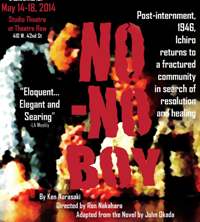
It may say something about our current sensibility that recent attempts to adapt this novel to the stage or screen consistently veer toward the easy answer of a love-conquers-all scenario involving Ichiro and Emi, the abandoned wife. But Okada places their final romantic encounter 40 pages and two chapters from the end of Ichiro’s journey. Through his brilliant organization of the material, Okada states clearly his artistic intent. He refuses the idea of a happy ending. Love is not enough. As Ichiro might say, “the problem is bigger,” and Okada makes it clear it is something that Itchy will have to fight through for years to come.
At the time he wrote, Okada could not foresee how the Sansei would grow to take up the mantle of justice for the camps and redress, and make sense of the camp resistance. He could only hope something was coming. In the darkest part of the night for postwar Japanese America, even as Ichiro thinks and probes for answers not only for himself but for all those in his world, he can see “a glimmer of hope … a faint and elusive insinuation of promise.” And in that precise balance, and in the rigor of Ichiro’s arc, lies the greatness of this novel.
No-No Boy stands the test of time. It’s still the great Japanese American novel.



 A full house at the Japanese Cultural and Community Center turned out to hear the story of Block 42, where in February of 1943 military police illegally rounded up three dozen men for refusing to answer either a Selective Service questionnaire or an Application for Leave Clearance, both of which included a troubling loyalty oath.
 Playwright Hiroshi Kashiwagi testified to what he witnessed: the ringing of the mess hall bells at 5pm sounding the alarm of the arrests, the military police hauling out the men from Block 42, the mothers and sisters screaming for the men not to be taken.
 Mamoru “Mori” and James Tanimoto of Gridley told how they were sent to an outside jail and then held without charge at a former Civilian Conservation Corps camp. There they were interrogated, rousted at night under bright lights, and made to hear the clicks of guards ominously loading their rifles as if ready to shoot, making the men believe they were going to be executed. Then from the darkness a voice shouted no one was going to escape under his watch, and the men were returned to their barrack.
 Martha Nakagawa for recognizing CONSCIENCE and RABBIT IN THE MOON in her remarks as “the two films that together led JACL to apologize” for its wartime suppression of camp resistance.
